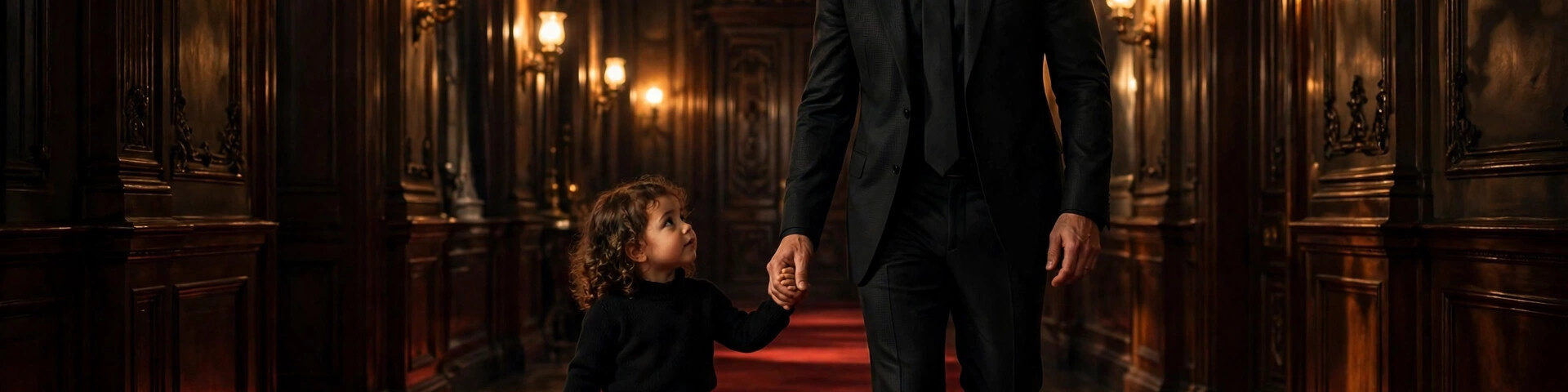
“Mia.” He kept his voice as low as he could. “How long has Miss Vivien been talking to your mother like that?” She thought about it the way small children do — seriously, without hurry — then lifted her hand and held up three fingers. Three days? She shook her head. Three weeks? She shook her head again and pressed the three fingers firmly against his chest. “Three months,” Lorenzo said quietly. She nodded. Then, as if she had been carrying it all those months and had finally handed it to the right person, she leaned her forehead against his shoulder.
He held her there a long moment. Then he lifted the desk phone. “Rocco. In my study. Now.”
Rocco Bianchi came without a jacket, sleeves rolled to the elbows. Twenty years beside Lorenzo, twenty beside Lorenzo’s father before that. “Every name on the household payroll,” Lorenzo said. “Every temporary contractor who has walked through the gates in the last four months. Their references. Their family names. Their bank accounts, if you can reach them quietly. No one hears you asking.” Rocco did not ask why. He inclined his head once and left without a sound.
Downstairs, Vivien was already waiting in pale green silk, her hair pinned the way she knew he liked. When she saw him on the staircase, her face softened into the exact expression she had worn for three months at every dinner, every gala, every photograph. She held out her hand. He took it, lifted it to his lips, and held her fingers a heartbeat longer than usual, so that she would think he had missed her. “You look tired, my love,” Vivien said. “Was the meeting hard?” “Long,” Lorenzo answered. “Not hard.” She smiled up at him — beautiful, poised, flawless. In this house, she was something else entirely. And Lorenzo now knew it.
The Medicine No One Prescribed
By seven thirty the next morning, Lorenzo entered his mother’s suite carrying breakfast himself. Mia was on the rug arranging wooden animals in a crooked line. Isabella sat in her wheelchair, and when she saw the tray, one eyebrow lifted — the same eyebrow that, before the stroke, had ended arguments. Then he held up a small amber bottle Rocco had taken from her medicine cabinet the night before.
Dr. Antonio Salvi had treated Isabella since before Lorenzo was born. He had delivered condolences at Enzo Duca’s funeral and eaten Christmas dinner in this house twice. Trust, Lorenzo was learning, was a word he suddenly distrusted.
At eight forty, Dr. Gabriel Bellini arrived through the service entrance in jeans, carrying an unmarked black medical case. A former trauma physician, he had once ordered Lorenzo’s father out of his emergency department after Enzo threatened a nurse. Lorenzo trusted men willing to be rude to power. Bellini examined Isabella for nearly an hour, photographed every bottle, sealed samples in bags. Then he said it: one medication was not on any plan he had created after the stroke. A sedative — one that increased drowsiness, dulled alertness, worsened balance and confusion. For a woman recovering from a neurological injury, it could make her look far more impaired than she truly was, and strangle her therapy and her ability to communicate.
Later, in the study, Elena finally told him the rest. Vivien had begun visiting Isabella’s room alone in June. When Elena refused to leave them unattended, Vivien complained to the house manager; a week later one of Elena’s paychecks was “accidentally” withheld, and another week later Mia’s preschool deposit vanished. “People like me don’t get meetings with people like you,” Elena said. “We get instructions.” Vivien kept asking whether Isabella had ever spoken positively about the wedding. His mother could not speak — but every time Vivien raised it, Isabella grew agitated. Once she threw the writing board across the room. Three weeks earlier, Elena had walked in while Vivien was going through the medicine cabinet. Isabella had become frantic, writing the same word over and over.
Then Rocco laid the trust documents on the desk, and the trap became visible. Lorenzo’s father had structured the legitimate Duca holdings through a family trust. Isabella held the controlling vote until Lorenzo married or she died. “If I marry,” Lorenzo said slowly, “Mother’s controlling vote passes to me.” “And under the revised marriage agreement,” Rocco finished, “you can designate your spouse as proxy if you’re incapacitated.” The revisions had arrived six weeks ago. Vivien had requested them as “routine.” Outside, Mia chased a butterfly along the terrace. “Vivien could have married someone richer,” Lorenzo said. Rocco placed another photograph on the desk — security footage from a private airfield. “She didn’t begin this three months ago.” Whatever Vivien wanted from the Duca family, she had brought blood with her.
The Name Hidden in the Ledger
Carlo Russo had been back in the city for forty-three days — three hotels, two rented vehicles, an apartment leased by a company that did not exist. By three in the afternoon, Rocco discovered something worse: Dr. Salvi had received six payments from that same company, the first landing two days before Isabella’s medication changed. “Find every connection between Russo and Duca going back thirty years,” Lorenzo said. “If I’m asking for the truth, I don’t get to choose which part.”