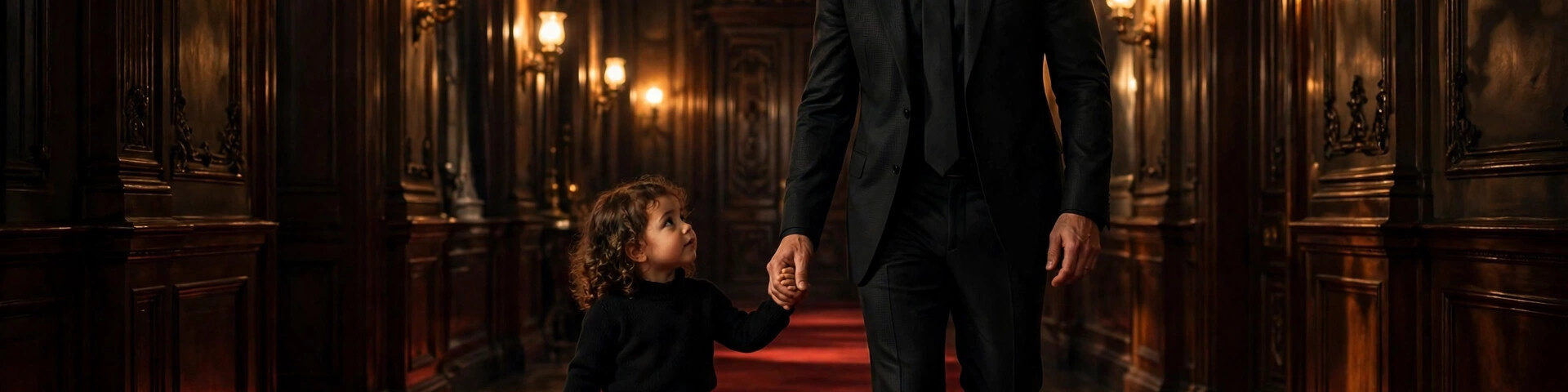
Isabella Speaks One Word
Three days later, the estate changed. Forensic accountants carried boxes from Lorenzo’s study. Employees were interviewed one by one. For the first time in decades, no one was instructed to lie for the family. Valenti was arrested for falsifying Pier Seven safety records. Salvi agreed to testify against Carlo and Vivien. Pietro faced charges for forcing Jonas Reed’s vehicle off the highway.
His mother had shouted his name from windows when he was a boy. For months he had believed he might never hear it from her again. Now the broken version sounded more beautiful than any voice he remembered. One word. Lorenzo. That evening, on the chapel steps, Elena told him she wanted Mia to have a normal life. “Nothing gives Mia her father. Nothing gives Antonio Russo back to his children.” “I spent years believing consequences were for other people.” “Maybe that’s the most dangerous thing power teaches.” For the first time in years, the future frightened him because he wanted one.
The next morning, Mara Vance arrived with two federal agents. “Lorenzo Duca, we have a warrant for your arrest.” Isabella descended the stairs one step at a time with Bellini’s help, and touched her son’s face. For decades he had walked through those doors surrounded by men who feared him. And somehow, for the first time, he felt as though he was becoming free.
The Trial That Put the Duca Name on the Stand
The newspapers called it the trial of the decade. For six months, prosecutors dismantled the Duca organization in public. Lorenzo admitted more than his attorneys advised — his lead counsel, David Mercer, stared at him as though contemplating murder. He did not confess to crimes he hadn’t committed. But when records proved responsibility, he stopped hiding behind subordinates, and that shocked people more than denial would have. Criminal enterprises were converted into legitimate companies under court supervision. Pier Seven’s surviving workers received settlements. Elena used most of hers to create a workplace safety fund in Luca’s name.
Vivien pleaded guilty to coercion, conspiracy, fraud, and the medication crimes; her testimony against Carlo reduced her sentence. Recordings connected Carlo to Jonas Reed’s death through Pietro. Before sentencing, she asked to speak to Lorenzo — two people who had once planned a wedding. “Love doesn’t automatically make people good,” she said. “Sometimes it just gives them more ways to hurt each other.” Lorenzo’s own sentencing came three weeks later: nine years in federal prison, with credit for time served. Mia, now four, waited outside with Rosa. After court, Elena was allowed a brief word. “You taught Mia that consequences matter.” That sentence traveled with Lorenzo to prison.
He took accounting courses though he already understood numbers better than most instructors, and helped men write letters to children they had disappointed. Isabella started a foundation for workers’ families. Rocco managed a legitimate logistics company and complained constantly about taxes. Mia’s first letter contained six words, beneath a drawing of something that looked like an exploding potato. He kept it above his bunk for eight years — because good behavior reduced his sentence. And while he served his punishment, the house he had left behind began becoming something he had never imagined.
The House With Open Gates
By Mia’s eighth birthday, the estate no longer had armed guards at the main entrance. The east wing became temporary housing for women and children leaving dangerous homes; the ballroom, a legal-aid center twice a week; the billiards room, a classroom. A bronze plaque near the entrance read: THE ISABELLA DUCA CENTER FOR FAMILY SAFETY AND WORKER JUSTICE. Elena worked at the center three days a week and a hospital clinic the other days — the first time Lorenzo saw her in blue scrubs on a video call, he forgot what he had been saying.
During his sixth year inside, Isabella suffered another setback. Rocco pushed her wheelchair into the prison visiting room, and on the drive home she asked him to stop at Antonio Russo’s grave — avoided for nearly thirty years — where she placed white roses beneath his name. That same year, Elena received a letter from Vivien admitting what she had done was abuse, that threatening Mia had been unforgivable. Forgiveness, Elena understood, was not a debt victims owed. During his seventh year, Lorenzo moved to a lower-security facility; during his eighth, a release date appeared. His greatest fear was no longer being forgotten — it was returning to discover the people he loved had healed better without him.
On March 17, he packed everything he owned, including the yellow star sticker Mia had once placed on Isabella’s sleeve, preserved between two pieces of plastic. The estate was unrecognizable: children on the lawn, a food truck in the circular drive, a sign announcing free legal consultations. Rocco had renovated the old groundskeeper’s cottage for him. For one second Lorenzo could still see the three-year-old who had taken his hand in a hallway — then she collided with him.
What Mia Remembered
Children forgot nothing. She remembered the walnut desk, and sleeping beneath Lorenzo’s jacket. When Mia turned eleven, the questions became impossible to avoid. “People died because of decisions I made,” he told her. “Because I grew up believing violence solved certain problems. Because stopping would have required admitting I was wrong. People can do terrible things and still change.” She brought him to the second-floor corridor, to the exact spot where she had once tugged his hand. “Because listening isn’t the same as choosing,” she said, and he realized she had been listening all along.