That evening on the porch, Elena said, “People assume I’ve been waiting for you.” Eight years earlier, on the chapel steps, there had been handcuffs waiting. This time there were none. From the mansion, Isabella watched through binoculars — and for once, the word waiting no longer felt like a threat.
The Last Debt
Three months after his release, a letter arrived without a return address — a photograph of a woman in her sixties. Maria Russo opened the door and stared at him for a very long time. “Because I carried the same name and repeated some of the same choices,” he said. “My father wrote that he offered you money. I thought you should have what he should have given you himself.” Maria pressed the letter against her chest.
Working with historians and investigators, Lorenzo opened the remaining family archives. The mansion placed Antonio Russo’s name on a memorial wall beside workers, witnesses, and families harmed during Enzo’s era. That winter Isabella’s health declined again, and Lorenzo moved into the mansion to help. Three months later, he proposed properly — Mia held the ring and nearly dropped it into a fountain. Workers from the center attended beside judges, nurses, teachers, and families who once would never have been invited onto the property. Lorenzo wore no symbol of his old authority. Before Elena walked down the garden aisle, she paused beside her daughter.
You Don’t Have to Whisper Anymore
Isabella Duca died three years later in her sleep. The night before, she ate too much tiramisu, argued with Rocco about baseball, and told Lorenzo his new haircut made his head look square. At her funeral, the chapel doors remained open — former prisoners Lorenzo had met inside, children Isabella had helped send to school. Mia, fourteen now, placed the yellow star sticker beside Isabella’s photograph and stepped up to speak.
“Grandma Isabella once told me I saved her. I remember pieces. A hallway. A door. Being scared. Finding Uncle Lorenzo.” Laughter rippled through the chapel. “Except he’s technically my stepfather now, which is annoying because I’ve called him Uncle Lorenzo my whole life.” She looked toward the empty wheelchair near the altar. “She said brave people aren’t the people who aren’t scared. They’re the people who decide someone else matters more than the fear.”
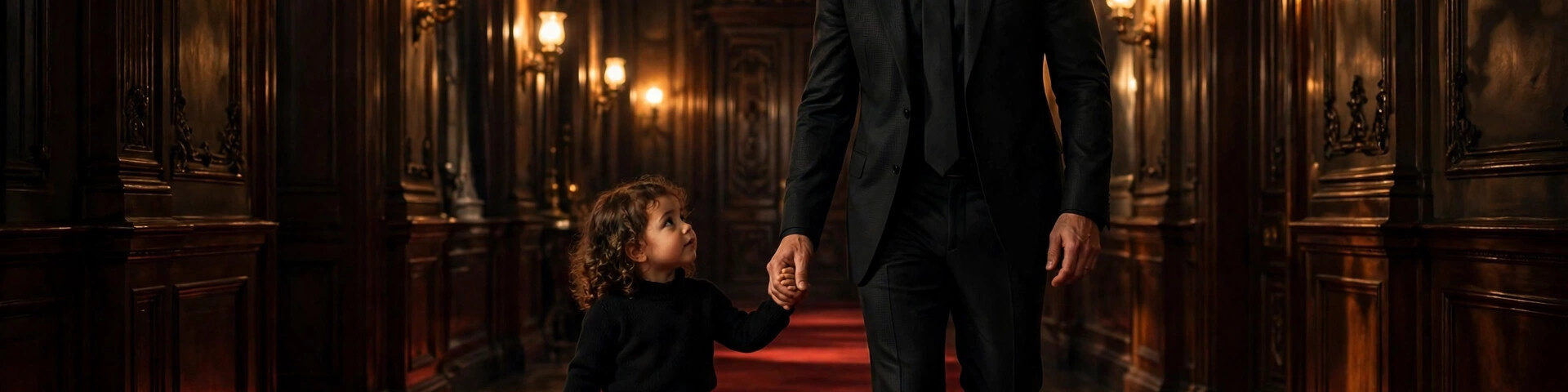
After the funeral, Lorenzo stood alone in the second-floor corridor — Isabella’s old bedroom was now a therapy room. “Do you ever think about what would’ve happened if I didn’t find you?” Mia asked. “You gave me a moment I couldn’t ignore.” At fourteen, her hand was no longer tiny, but he remembered when it had disappeared completely inside his palm. “I remember thinking everything was okay because you knew.” “It became okay because you did something.”
Downstairs, Elena waited near the open front doors — older than the frightened maid who once stood against Isabella’s wall holding a folded towel. A new building stood beside the original center: a school and transitional housing for families of injured workers and victims of domestic violence. Lorenzo had refused to put his name on it. The plaque read: NO ONE SHOULD NEED PERMISSION TO BE SAFE. Outside, a reporter asked, “How do you want people to remember you?” He looked at the families carrying boxes into rooms that would keep them safe tonight. “I don’t get to choose what people remember,” he said. “I’d rather people decide what I do next.”
Near the new building, Mia was crouched beside a little girl in a red skirt, the child’s mother speaking to a counselor a few yards away. No one needed to whisper for a powerful man to notice. Then, almost as though she had read his mind, Mia looked up and said: “You don’t have to whisper anymore.”
He thought of the man he had been when a three-year-old girl first took his hand — a man who believed strength meant nobody dared threaten what belonged to him. Strength was telling the truth when lies would protect you. Accepting consequences when power could delay them. And listening when the smallest voice in the room was the only one brave enough to speak. Behind them, the autumn wind moved through the trees, and for the first time in generations, no one in the Duca house was afraid of what might happen if the truth got out.