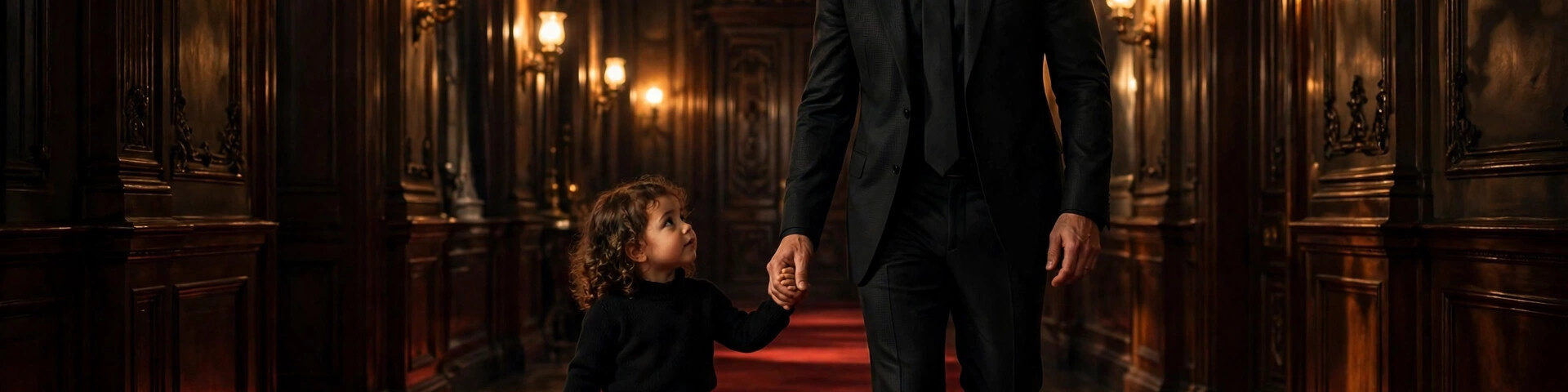
The hand that slipped into Lorenzo Duca’s was smaller than his palm and far more certain than it had any right to be. It tugged once, hard, and the most feared man in Chicago allowed himself to be led down the second-floor corridor by a three-year-old girl in a red skirt.
“Shh,” Mia whispered, pressing one finger to her lips. “Don’t speak, uncle. Follow me.”
Late-afternoon light fell across the red carpet in long amber bars, and the whole house seemed to be holding its breath. Three quiet steps. Then the child stopped and pointed. Isabella Duca’s door stood open no wider than the width of a hand. Lorenzo sank to one knee beside her, and together the mafia boss and the toddler crouched at the doorframe, and he bent his ear toward the narrow slit of light.
Inside, his fiancée Vivien Russo stood with her back to the tall windows. Elena Reichi, the young maid, was flattened against the opposite wall, a folded towel still clutched in her hands. Between them, in the wheelchair by the window, Isabella Duca sat perfectly still, one hand resting on the writing board in her lap. Only her fingers moved — small, trembling, dry as paper. The silver crucifix at her throat caught the light with every breath.
Vivien’s face was one Lorenzo had never seen. A week earlier in the garden she had straightened Elena’s apron with the tenderness of a sister. Now her mouth was a thin line, her jaw set, and every trace of softness had drained from her voice — the voice of a woman who had been rehearsing this conversation for weeks.
“You will go to him tonight,” Vivien said. “You will tell him his mother has given her blessing. That she is happy. That she wept, if you can manage it. And if you don’t—” a pause — “you leave this house by Sunday. Without a reference. Without a name. No family in this city hires a maid dismissed from the Duca estate. You understand what that means. You understand where women like you and your child end up.”
Elena did not answer. Vivien let the silence settle onto her shoulders like a wet coat. Then she stepped closer, and her voice dropped the way a blade drops when it finds the space between two ribs.
“And your little girl? A three-year-old running through corridors she does not know. Gardens with gates that do not always lock. Cameras that do not always work.” Vivien tilted her head. “It would be a terrible thing if such a child wandered somewhere she should not.”
Behind the wheelchair, Isabella’s hand jerked — one sharp knock against the wooden arm of her chair. Vivien did not turn. She had long ago learned how to hear that sound and not hear it.
In the corridor, Lorenzo did not move. He looked down at Mia and understood why she had come to him instead of running to her mother. She had heard this before. Somewhere inside her, in the way only children understand, she had worked out that the person who could stop it was not the person crying.
Rage rose in his chest like a tide behind a wall. He did not let it break. Every muscle in his body wanted that door open — he had buried men for less than what he had just heard. His hand was already on the frame when he stopped himself. If he walked in now, he would only learn what Vivien was willing to let him learn. And the woman who had rehearsed those threats had rehearsed her denials twice as long.
So he lifted Mia into his arms instead. She weighed almost nothing. He carried her down the corridor in silence and closed the study door behind them, setting her on the edge of the walnut desk. Her small legs did not reach the floor.