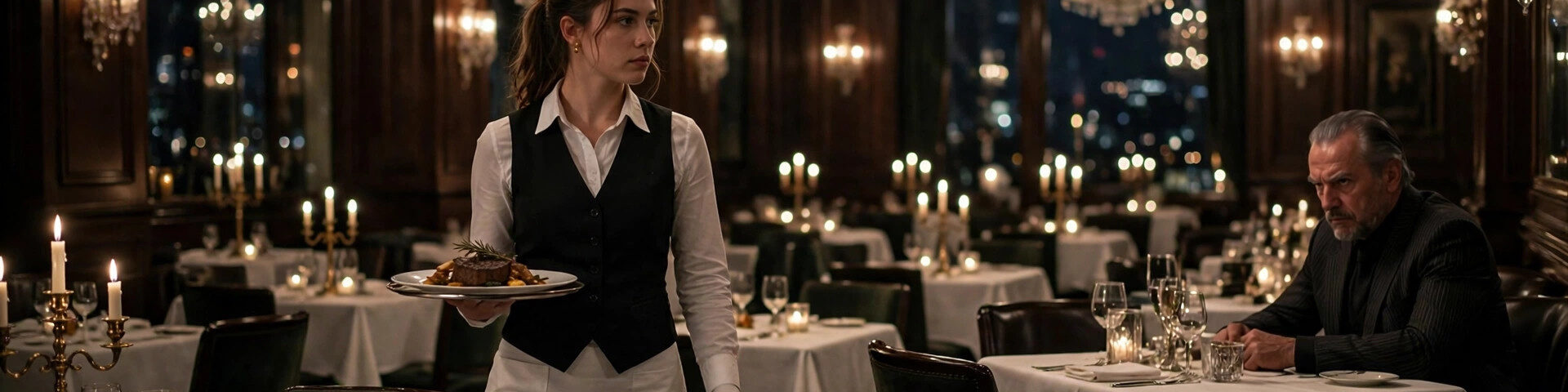
“Lock the doors,” he said to his men, and just like that the restaurant became a crime scene. A businessman at a corner table started to protest and Matteo told him to sit down in a voice so low and so final that the man folded back into his chair without another word. The brass lock on the front doors clicked. Then Matteo turned toward the kitchen doors. “Who touched this plate after she cooked it?” The head chef came out white-faced and stammered that he had plated it, that a young kitchen assistant named Marco had garnished it, that I had carried it. “Anyone else?” Matteo asked. “No, sir.”
A man I had never seen before came out of the private dining room carrying a small black case. He pulled on gloves and scraped a sample of the sauce into a vial while I stood there with my heart hammering so hard I was sure everyone could hear it. Matteo never took his eyes off me. “You said your mother taught you this,” he said. “When?” “When I was little,” I said. “Where?” “At home.” “In Chicago?” “Mostly. We lived in Cicero for a while.” His jaw tightened. “What street?” “I don’t remember.” “That isn’t true.” And suddenly I was angry, because fear had filled me up to the brim and there was nowhere left for it to go. “You don’t know me,” I said. “No,” he said, leaning closer. “But I knew your mother.”
The words hit me harder than anything else that night. My mother had been dead eleven years. Cancer had taken her slowly, and I had sat beside that hospital bed holding her hand and memorizing the smell of lemons on her skin, and in all those years she had never once mentioned the name Matteo De Luca. “You’re mistaken,” I said. “I don’t mistake faces or names,” he said. “My mother never mentioned you.” Something humorless crossed his face. “That doesn’t surprise me.”
The man with the black case came back and murmured something to Matteo, and Matteo’s expression turned to stone. I finally found my voice. “What was in it?” The man with the case looked at Matteo, then at me, and said, “Something that shouldn’t have been.” My mouth went dry. “I didn’t put anything in there.” Matteo studied me for a long moment. “I believe you,” he said, and somehow that terrified me more than anything else. “How can you?” “Because,” he said, “if you had wanted me dead, you would never have stepped forward.”
The Crash in the Kitchen
Then there was a crash from the kitchen, and everything broke open at once. Matteo’s men moved through the swinging doors like water. Shouting. Running. Someone yelled, “Back door!” Matteo didn’t move — he just watched me, and I understood with a cold jolt that he wasn’t guarding himself against me. He was guarding me against whoever was running. Luca Ferraro, his right hand, came back a minute later. “Marco’s gone,” he said. “Left his phone. Back alley door was open.” Marco — the kid I had worked beside twenty minutes earlier, the one who had handed me the ticket for Table Twelve. “Find him,” Matteo said.
My own phone started ringing at the service station. UNKNOWN CALLER. Luca said, “Don’t answer.” I answered anyway. There was breathing on the line. Then a distorted whisper: “Isabella should have kept her promise. And so should her daughter.” The line went dead, and my blood turned to ice water.
A waiter came hurrying in from the employee corridor holding my handbag. “It was open in your locker,” he said. “You need to see this.” I grabbed it and dumped it open, and there, under my wallet and my keys and my lipstick, was my mother’s old recipe notebook — the one I kept in my apartment drawer, the one I never, ever brought to work. Someone had broken into my home and planted it in my bag. I opened the cover with shaking hands, and a photograph slipped out and fell to the floor.