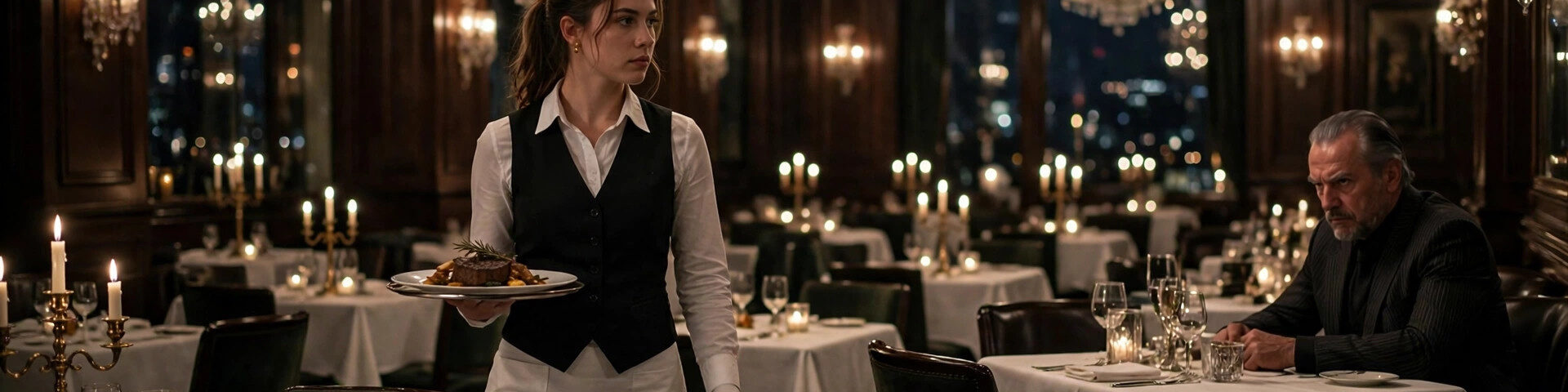
Matteo bent down and picked it up. His face changed completely. I looked over his hand and saw my mother at twenty-four, radiant, unmistakably pregnant — standing beside a much younger Matteo De Luca with his arm around her waist. On the back, in faded ink, three words I couldn’t quite read. Matteo read them. He looked up at me. And before either of us could speak, the locked front door rattled. Once. Twice. Then three slow knocks. Every man in the room reached inside his jacket. A voice came through the glass: “Matteo. Open the door.” Matteo went pale. “Who is that?” I whispered. He stared at the entrance the way you stare at a ghost. “My brother.”
The Brother at the Door
The door opened three inches before Luca slammed his palm against it. Carlo De Luca stood in the hallway — fifty-six, silver-haired, broad-shouldered, a charcoal overcoat over a suit that cost more than my car. “You haven’t called me Matteo since our mother died,” Carlo said, and I realized I was watching an old war resume in real time, right there in the corridor of a locked restaurant. “Why would anyone care about a waitress?” Carlo asked. Matteo didn’t look away from his brother. “Because you already know exactly who she is.”
They went into the private dining room, and I waited in the corridor with Luca while my mind rejected the conclusion the photograph had been forcing on me for the last ten minutes. When Matteo finally came out, his face was gray. “Anthony Rossi was your mother’s husband,” he began. “Anthony married Isabella when she was already pregnant.” My fingers tightened around the photograph until the edges bent. All the small things I had never noticed suddenly sharpened — the slant of my mother’s handwriting in the recipe notebook, matching the note on the back of the photograph. “My mother raised me alone while you became whatever this is,” I said, and immediately hated how cruel it sounded. His voice dropped. “A man came to me once. He told me Isabella had married him and wanted nothing more to do with the De Luca family. I was twenty-five. My father had just been killed. There was a war happening around us.” He showed me the torn half of a matching photograph he carried in his wallet — his copy, ripped in two twenty-five years ago. “I believed him,” he said. “I have spent twenty-five years believing him.”
That night, after the restaurant finally emptied and the police contacts Matteo trusted had taken everyone’s statements, I went home and found the lock on my apartment door scratched and my mother’s recipe notebook gone from its drawer — the same notebook someone had slipped into my work bag. My mother’s handwriting ached to look at. Tucked behind several cards was a folded page of translucent paper covered in columns of numbers. When I showed it to Matteo, he unfolded it slowly. “These numbers may be part of the missing ledger,” he said. “My father had been stealing from his own partners. Isabella discovered where the money went.” A disposable phone found near the restaurant had placed a call two blocks away; the shell company behind it had been created three weeks earlier. Someone was dragging my dead mother’s name through every piece of evidence, and I was starting to understand why.
In the car, while Luca drove us through empty streets with the headlights off, Matteo told me about Carlo. Their father had built the De Luca name on fear and kept it with blood. Matteo, the elder, had inherited the throne and spent thirty years trying to turn an empire of violence into something that could survive daylight. Carlo had inherited only the hunger. He had spent his life proving he was the stronger son — building his own hidden network inside the family’s legitimate businesses, skimming, bribing officials, keeping two sets of books — while telling anyone who would listen that Matteo had gone soft. Their father had discovered the theft first. Then Isabella, twenty-six years ago, had found the proof by accident: ledgers, account numbers, names of bought men. She had been twenty-four, in love with Matteo, and carrying his child. Carlo had given her a choice wrapped as mercy — disappear, marry someone else, never speak of what she’d seen, or the child would never be safe. Isabella had chosen the child. She had chosen me.
“He told her that if she stayed near me, the child would never be safe,” Matteo said, his voice flat with a rage twenty-five years old. “And I let her go. I was twenty-five, burying my father, fighting a war — and I let the love of my life walk away with my unborn daughter because I was too proud and too busy to chase her.” I stared out the window at the sleeping city. Matteo didn’t flinch. “Your mother raised you alive,” he said. “That was the victory. Everything else is just the bill coming due.”
The Envelope
“Your mother trusted Matteo once,” Luca told me the next evening. “It nearly killed her.” We left Bellavita through the rear entrance and drove to an abandoned social club in Cicero, where a man I had believed dead for eleven years was waiting in the dark. Anthony Rossi — the father on my birth certificate, the man who had visited twice a year until I was twelve and then stopped when my mother got sick — stood up from a folding chair and said my name like a prayer. “You don’t know me,” I said. “You shouldn’t trust me.” His eyes were wet. “Because you shouldn’t trust Anthony either,” he said. “The Anthony you’ve been looking for isn’t the whole story.”
He handed me a sealed envelope in my mother’s handwriting. “Your mother gave me that three days before she died. She said: when Matteo finally learns you exist, give it to her. Because she knew the De Lucas would come.” My hands shook as I broke the seal. My mother wrote that Anthony had protected us both, that she had loved Matteo but feared the world around him — and then I reached the sentence that changed everything: If Matteo is standing beside you when you read this, then he finally knows the truth: you are his daughter. Matteo De Luca, the man who could silence a restaurant with three words, had to sit down. My mother had written that she never stopped loving him, but love was not enough to make his world safe. And she had written one instruction for him: Being her father is not something blood gives you. It is something she must decide whether you deserve.