The Brick House
The house stood on a quiet street west of Chicago — small brick, faded shutters, a garden that had long ago surrendered to weeds. Nothing about it looked connected to the De Lucas. I stood outside holding my mother’s key and whispered, “Okay, Mom,” and went in. Matteo held my mother’s final letter beside an old brass key, and together we walked through rooms she had kept for twenty-six years. A bedroom held boxes labeled by year — letters she had never sent to Matteo, following his life from a distance: his business deals, his lonely reputation, the way he never remarried. A photograph of Matteo and my mother laughing, young and impossibly alive.
Her last letter broke us both open. She told Matteo she forgave him for not finding her. She told me I had never been a secret born from shame — I had been loved before I took my first breath. And then came the words that finally let us breathe: Please don’t build your future around what happened to me. Carlo took enough years from us. Don’t give him another day. I spent too many years believing safety meant keeping people apart. The most feared man in Chicago had tears in his eyes. Matteo held his daughter for the first time — not like a man trying to recover twenty-five stolen years at once, but like a father who finally understood that the past could not be reclaimed, only answered.
Six months later, Bellavita looked different. The locked private dining room was gone. The ownership structure had changed. Marco, after completing his cooperation agreement and serving his sentence, wrote me a letter I kept in my desk: You made a terrible choice. Then you tried to stop it. Build the rest of your life around the second choice. He sent postcards from nowhere, without return addresses. Matteo withdrew completely from what remained of the family’s criminal operations and closed every business that couldn’t survive scrutiny. For the first time since he was twenty-five, Matteo De Luca lived without trying to control an empire. Three weeks into it, I found him reorganizing Bellavita’s wine cellar. Our relationship was no longer built entirely around a dead woman and a terrible secret. We were creating memories that belonged only to us — Matteo discovering that I hated opera, me discovering that Matteo secretly watched baking competitions. “You tell anyone,” he warned, “and you’re out of the will.” “Then I’ll take it back specifically so I can remove you,” I shot back, and we both laughed like people who had forgotten how.
One Year Later
A year after the night of the poisoning, Bellavita held an anniversary dinner. I cooked the dish myself — my mother’s recipe, exactly as Isabella had taught me. “Your mother specifically said never to change the recipe,” Matteo said, watching me work. “She also said not to build our future around her past,” I answered, and added the final ingredient the way she always had. Later that evening, I stood near the open kitchen watching a young waitress carry my mother’s dish toward a couple celebrating their fortieth anniversary, and a year earlier that distinction would have mattered enormously. Now it just felt like dinner. A framed photograph hung beside the entrance — not my mother the woman who uncovered Carlo’s crimes, just Isabella Rossi standing in a kitchen, laughing with flour on her cheek. It contained no mention of the De Luca family. “I think she’d tell you your tie is too expensive,” I said. “And then she’d probably tell you she’s proud.” “But she’d still complain about the tie,” Matteo said.
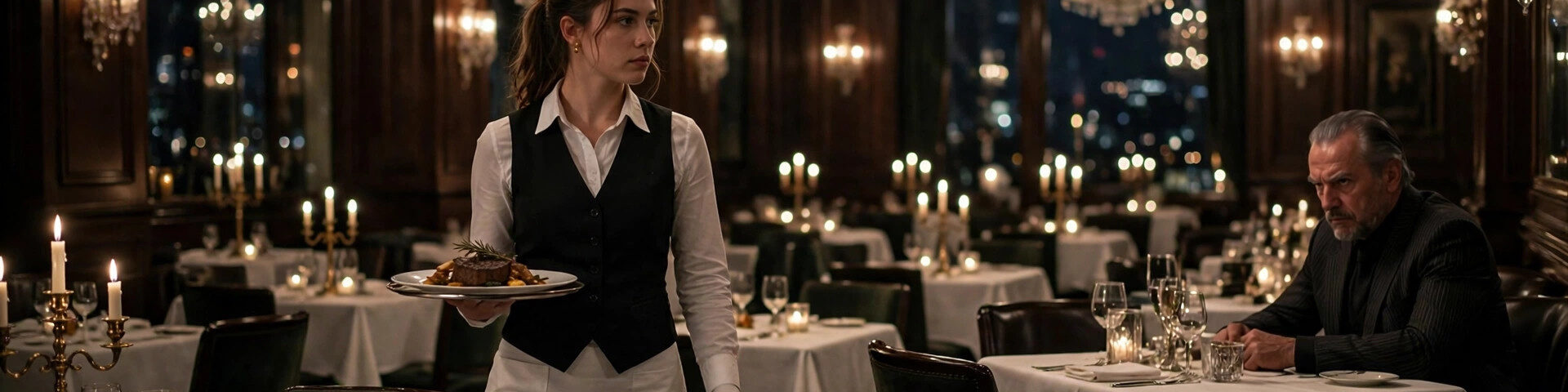
The anniversary menu was my mother’s from start to finish — every dish she had ever cooked at Bellavita, reconstructed from the recipe notebook I now kept in a fireproof safe. The dining room was full: old regulars, the staff and their families, Luca Ferraro in a suit that clearly made him uncomfortable, and at Table Twelve, Matteo De Luca, watching his daughter run a kitchen the way a conductor watches an orchestra. Halfway through the evening, I stepped out of the kitchen in my chef’s whites, and the room stood and applauded — not for the drama, not for the headlines, but for the food, which was extraordinary. Priya, the waitress with two kids in Catholic school, was now the dining room manager. Marco’s empty chair at the staff table had a place card on it anyway. “He’ll come back when he’s ready,” I had said. “The door stays open.”
Near midnight, the last customers departed, and I turned off the dining room chandeliers one row at a time. A year earlier, the same room had gone silent because everyone believed someone was about to die. Tonight it became quiet for an entirely different reason. Outside, streetlights reflected against the pavement, and Matteo emerged from the kitchen carrying a small white takeout box. “You said you were watching your cholesterol,” I said. “I lied,” he said, and handed me the box. No secrets followed us through the door. For the first time in twenty-five years, my mother’s recipe belonged to a family instead of a mystery — and I finally understood why she had insisted I remember it. Not because the past should be preserved exactly as it was, but because sometimes one familiar taste can survive years of silence, cross the distance between two strangers, and bring a father and daughter to the same table. Matteo had spent half his life believing power meant never showing anyone where he could be hurt. But when I looked beside me now, he was there. And tomorrow morning, he would still be there.