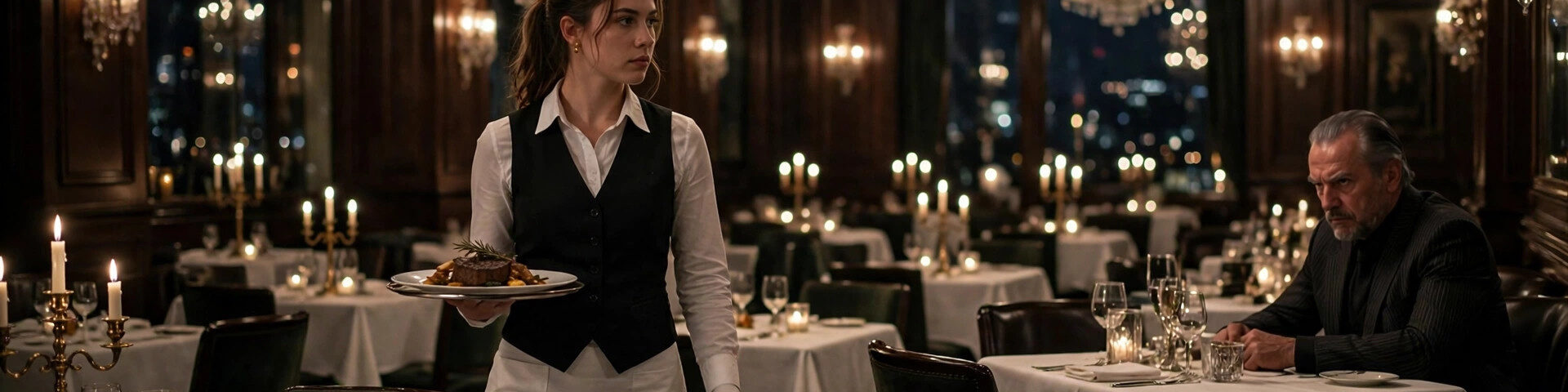
One afternoon during the siege, I found three waitresses crying in the locker room. “We’re going to close, aren’t we?” one asked — a woman named Priya who had worked at Bellavita for nine years and had two kids in Catholic school. I looked at the fear on their faces and made a promise I had no authority to make: “No one loses a paycheck because of my family.” I said it before I knew about the deed, before I knew I owned half the building. I said it because Isabella Rossi had raised a daughter who couldn’t watch working women cry and walk away. Later, when the lawyers explained what forty-nine percent meant, my first instruction wasn’t about Carlo or Matteo or revenge. It was: “Nobody gets fired. Nobody’s hours get cut. Whatever happens, the staff is protected.” Matteo, listening from the doorway, said nothing — but Luca later told me it was the moment Matteo stopped seeing me as a victim to protect and started seeing me as an heir to respect.
The media called me the Mafia Heiress. Talk shows debated whether I was a gold digger or an assassin. A true-crime podcast released a three-part series in a week. Through it all, I refused every interview, and Matteo — who had avoided cameras for thirty years — gave exactly one statement, standing in the rain outside the courthouse: “She cooked a meal her mother taught her. Everything else was done to her, not by her. If you want a villain in this story, I’m available most evenings.” The clip ran for a week. I watched it in the apartment and laughed until I cried — the most feared man in Chicago, doing public relations with a straight face, for me.
Seventy-Two Hours
Matteo spent every one of the next seventy-two hours trying to get me out. By the third evening, my attorney had dismantled enough of the initial evidence to secure my release pending investigation — the vial, the phone records, Marco’s panicked attempt to stop the plate. But the damage Carlo wanted was already done. Reporters camped outside the apartment. “ELENA, DID YOU TRY TO KILL YOUR FATHER?” “DID YOU KNOW MATTEO DE LUCA WAS YOUR FATHER?” “ARE YOU PART OF THE DE LUCA ORGANIZATION?” I said nothing, head down, until Matteo stepped in front of the cameras himself. “I tasted the dish,” he said. “I know what happened. She is innocent.” A reporter shouted, “You just connected yourself publicly to her!” Matteo’s answer was quiet and final: “I should have been connected to her twenty-five years ago.”
Behind the scenes, the net was tightening around Carlo. Marco, terrified and remorseful, told investigators everything: the small vial, the money, the moment he’d realized what he’d done and tried to take the plate back. Matteo made the hardest decision of his life — he began cooperating with federal investigators, agreeing to testify against his own brother if necessary, handing over twenty-five years of records on the condition that the waitresses, cooks, and dishwashers of Bellavita would be protected. “Why didn’t you leave that world years ago?” I asked him one night. “I thought controlling it was safer than abandoning it,” he said. “I don’t know if I would have been strong enough to walk away then.” I respected the answer more than any romantic lie. “Now,” he said, “I’d burn every dollar before losing another person to it.”
But Carlo still needed one thing: the original ledger. Anthony explained that digital copies could be challenged by defense attorneys — only the original, with Carlo’s fingerprints, handwriting, and signatures, would be untouchable. And only my mother had known where it was. I stood in the center of Bellavita’s empty dining room, turning slowly, remembering my mother’s voice: put it where everyone looks but nobody sees. My eyes stopped on the decorative brass crest mounted at the center of the room — the one my mother had called a “reminder.” I climbed onto a chair, worked the crest loose from its mounting, and inside the hollow base lay a leather-bound ledger wrapped in plastic. Twenty-six years of Carlo De Luca’s crimes, in his own hand. I held it like it might burn me. Then, from the kitchen corridor, a voice I knew said, “You really thought Anthony Rossi was the only man who knew how to disappear?” The false Anthony — Carlo’s plant, hired years earlier to watch my mother, who had been impersonating the real Anthony since the real one vanished — reached into his jacket. Matteo grabbed my arm and pulled me toward the kitchen as the room erupted.
The Last Dinner
Carlo had hired the impostor years earlier to watch my mother, and he had played the part of a frightened father well enough to fool everyone — until the ledger surfaced. The real Anthony was found hours later, alive, in a warehouse outside Cicero, and entered witness protection voluntarily. Carlo’s network collapsed within forty-eight hours: three of his closest associates turned, the corrupt officials tied to his records faced prosecution, and the money trails my mother had mapped a quarter-century earlier finally led somewhere. “My mother spent twenty-five years hiding from him,” I said. For decades, Carlo had believed power meant making people afraid to speak. In the end, he lost because people finally did.
Bellavita reopened for one private dinner. Carlo came — older than he had looked a week earlier, the war finally out of him. “You know what’s funny?” he said, staring at the empty chair where his father used to sit. “Everyone thinks this was about money.” “You threatened a pregnant woman because you were jealous of your brother?” I asked. Carlo’s laugh was hollow. “You had money. Fear. Men who obeyed you because you paid them.” “My mother offered you a chance twenty-five years ago,” I said. “She promised not to expose you if you left Matteo and me alone. And you spent twenty-five years blaming her for what you chose.” Carlo lunged for the decoy ledger on the table like a desperate aging man realizing fear no longer worked — and federal agents were waiting in the kitchen. He was indicted on conspiracy, attempted murder, financial crimes, witness intimidation, kidnapping, and corruption charges. He eventually pleaded guilty after his own associates testified against him. I watched through the front windows as he disappeared into a federal vehicle, and felt nothing but tired.
I took control of my inherited forty-nine percent stake with one condition Matteo had never expected: “Too many secrets happen behind closed doors.” The locked private dining room was torn out. Waiters who had worked at Bellavita for fifteen years were given equity. Matteo transferred his own ownership into a trust. One evening, I found him alone at Table Twelve — the table where it had all started — turning over a small wooden box in his hands. My mother’s initials were carved into the lid. Beneath it, in handwriting I recognized instantly, was a note. On the back, an address neither of us recognized.