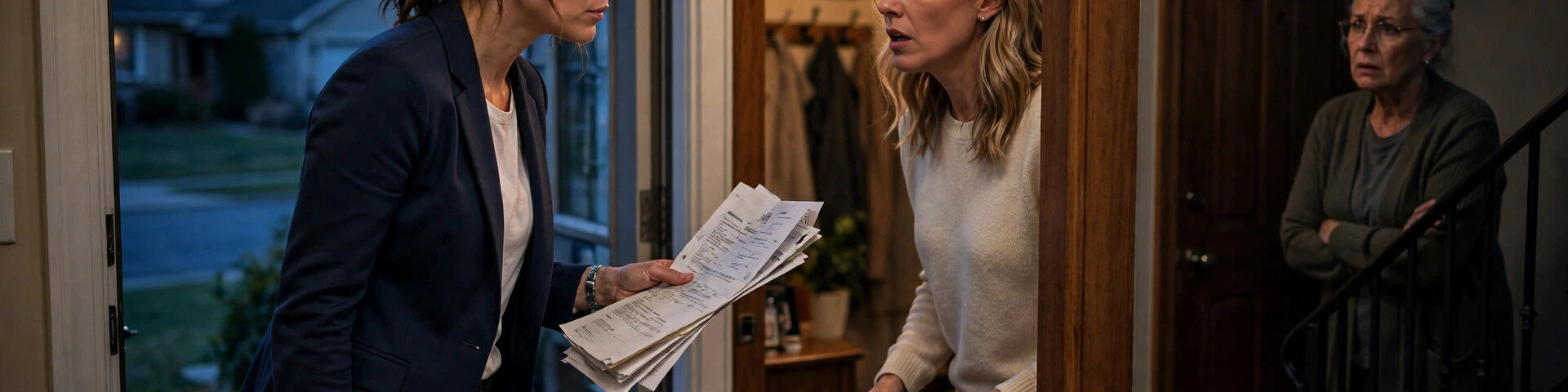
Dad died the following year.
He was sixty-seven.
He collapsed while working near the tomato bed he had been planning when we last spoke — the same bed, the same soil, the same unfinished plans. Travel restrictions and quarantine rules made returning home nearly impossible at the time, and I ended up attending my father’s funeral through a laptop screen in a staff apartment after midnight, the blue light of the screen the only illumination in the small room.
The connection froze twice.
I missed part of the eulogy — the part where, I later learned, his foreman talked about Dad’s hands.
I never forgave technology for behaving like ordinary technology during the worst hour of my life.
On that small screen, Vanessa stood beside Mom.
Her hand rested on Mom’s shoulder, and Mom leaned into it.
I remember thinking: Thank God she’s there. Thank God Mom isn’t alone for this.
One week after the memorial dinner, Vanessa moved two suitcases into the house.
“Temporary,” she told me over the phone, her voice warm with sisterly concern. “Mom shouldn’t be alone.”
I was grateful.
That word matters.
Grateful.
For years afterward, whenever guilt about staying overseas surfaced — and it surfaced often, in the quiet moments between services, in the dark of my small apartment — I reminded myself Vanessa was there.
Mom wasn’t alone.
Bills were paid.
The house was safe.
Every call seemed to confirm it.
Mom would sit at the same end of the kitchen table with a beige wall behind her and tea in both hands, steam rising in the frame.
“How are you, Mom?”
“Fine.”
“Do you need anything?”
“Nothing.”
“Should I come home this summer?”
“Don’t waste that kind of money, Bella.”
“I can afford it.”
“Save it.”
Another year.
Another promotion.
Another busy season.
Another reason not to fly home.
I told myself I was being responsible — that the restaurant needed me, that the money I sent mattered more than my physical presence, that Mom was safe and cared for.
By the time my contract ended, I had been away six years.
I decided to come back without telling anyone.
Not as a test.
As a surprise. I imagined Mom’s face. I imagined the yellow bedroom. I imagined cooking in that kitchen again.
I carried blue silk for Mom because you buy fabric for a seamstress, not flowers — flowers die, but fabric becomes something. In my wallet I still had the old key tied with the fading red ribbon she and Dad had once held together on Christmas morning, the ribbon now pale pink with age.
The key no longer worked.
That should have told me more than it did.
I stood on the porch inserting it twice, jiggling it with increasing confusion, before noticing the lock had been replaced — a sleek new deadbolt where the old brass one had been.
Then Vanessa opened the door wearing the pearls.
After she told me Mom lived in the basement, she checked her phone with the distracted air of someone whose real life was elsewhere.
“I have dinner plans.”
“You’re leaving?”
“I didn’t know you were coming.”
“That’s generally how surprises work.”
She looked irritated, as though I had inconvenienced her by existing in her space unannounced.
“Just don’t rearrange anything. The people upstairs have agreements.”
“What people?”
“Tenants.”
The word landed strangely, heavy and foreign in the context of our family home.
“You rent rooms?”
“Someone has to keep the house going.”
I looked at the staircase.
Three pairs of unfamiliar shoes lined up with military precision.
“Where do you sleep?”
She pointed upstairs with her chin.
“Dad’s office.”
“And Mom?”
“You saw where I pointed.”
Vanessa walked away.
Just like that — no further explanation, no acknowledgment of the enormity of what she had just told me.
Six years had passed and my sister left me standing in the entryway of a house whose monthly payment still left my account before the first Friday of every month, a house I had bought with seven years of sixteen-hour days.
I walked the rooms slowly, the way I had been trained to walk a new kitchen — observing before touching.
A chef learns to read a kitchen before tasting anything. You notice how knives are stored, whether pans are loved or abused, whether a refrigerator belongs to someone cooking for themselves or feeding strangers.
This kitchen had become communal, institutional.
Four labeled shelves in the refrigerator, each marked with a name in Vanessa’s precise handwriting.
A dry-erase board listing quiet hours in cheerful colors that felt menacing in context.
Plastic bins marked FRONT, BLUE ROOM, OFFICE — the house reduced to zones.
On the hall table sat rubber-banded envelopes with names and months written in Vanessa’s handwriting, little paper monuments to her enterprise.
Upstairs, the yellow bedroom had a man’s jacket hanging on the door.
Mom’s bedroom.
The one with morning light.
The one I had painted with such care.
The second bedroom had restaurant clogs outside it and the faint smell of fryer oil that clung to the hallway.
Dad’s old office contained folded medical scrubs, neatly stacked on the desk where he had once done his crossword puzzles.
Family photographs had been removed from the staircase wall and stacked on a shelf — decades of birthdays and graduations and Christmas mornings, face-down and dusty.
Our parents’ wedding picture lay face down, the glass reflecting nothing.
Then I noticed Dad’s skillet.
Still hanging above the stove.
Dry.
Dusty.
Untouched.
I took it down, my hands remembering its weight.
My father had seasoned that skillet for thirty years. The surface used to shine black as glass, smooth as a mirror from decades of careful cooking.
Now it looked gray, neglected, abandoned.
Then I heard something beneath the floor.
Three short mechanical bursts.
Pause.
Another.
A sewing machine — the particular rhythm of Mom’s Singer, a sound I had known since childhood.
I walked toward the basement, my heart hammering against my ribs.
There was a new brass slide bolt on the outside of the door.
Not locked.
Still, seeing it there — a lock designed to keep someone in, or out — made my stomach tighten with a cold dread.
I moved it aside and went down, each step deliberate.
The basement staircase was the only one I had never carpeted because nobody was meant to live below. Bare wooden steps. Concrete floor. Exposed utility pipes running along the ceiling like industrial veins. One small window near the ceiling, crusted with dirt, admitting a thin gray light.
Under the staircase sat a folding cot, the kind used for camping.
Beside it, a space heater, its orange glow the only warmth in the room.
A reading lamp with a crooked shade.
Cardboard boxes labeled in Mom’s careful handwriting, the letters precise despite everything.
CAROL — WINTER.
CAROL — BOOKS.
CAROL — KITCHEN.
And against the far wall, facing away from the tiny basement window, sat her Singer sewing machine — pushed into the darkest corner, as far from natural light as it was possible to be.
Mom was beside it, bent over some mending.
She turned at the sound of my footsteps.
For one moment, neither of us moved, the air between us thick with six years.
Her hair had gone completely silver, beautiful and shocking.
She looked smaller than I remembered, as though the basement had physically compressed her.
Then she made a sound I had never heard before — something between a gasp and a sob — and rushed toward me with surprising speed.
“Bella.”
I held her, breathing in the familiar scent of her shampoo mixed with basement damp.
She held me harder, her arms thin but fierce around my waist.
Then, before saying anything else, before asking about my flight or my life or anything at all, she started apologizing.
“It’s messy down here.”
My chest tightened until I could barely breathe.
“What?”
“I wasn’t expecting you. Let me straighten this.” She began lifting clothes from a chair with shaking hands.
“Mom.”
“I should have made the bed properly.”
“Mom.”
She bent toward a box and winced, her face contorting.
Her knee nearly gave way beneath her.
I caught her arm, steadying her.
“My God.” “I’m fine.” “No.” “I’m fine, Bella.”
There it was.
The same sentence from every video call, delivered with the same determined brightness.
Fine.
Now I could see what fine looked like.
A cot under the stairs.
A space heater.
Bare concrete.
Her sewing machine pushed into the darkest corner, away from the light it needed.
I brought her upstairs, my arm around her waist, feeling how light she had become.
Vanessa had left — slipped out while I was in the basement, her dinner plans suddenly urgent.
I took Dad’s skillet off the counter and washed it, working the gray film away with hot water and salt the way he had taught me.
Mom hovered anxiously.
“You don’t need to cook.”
“I want to.”
“I can make something.”
“Sit.”
That word usually started arguments between us — Mom had never been good at sitting still.
This time, she sat, folding her hands in her lap like a guest.
I made eggs and potatoes with butter.
Nothing elaborate — just the simple food of our childhood.
Mom ate as though I had served her a tasting menu, savoring each bite with closed eyes.
When she finished, she stood immediately and began wiping the counter.
Once.
Twice.
Then she crouched slightly to check the stovetop at eye level, her movements automatic and anxious.
“What are you doing?”
“Vanessa likes it clean for the guests.”
Guests.
The way Mom said it made the arrangement sound permanent, institutional, unquestionable.
“Do you cook for them?”
“Breakfast sometimes.”
“Do they pay extra?”
She looked confused, genuinely puzzled by the question.
“For breakfast?”
“Yes.”
“No, honey. They work hard.”
Of course.
My mother lived in the basement and cooked free breakfast for strangers paying rent upstairs in her own bedroom.
I almost asked everything at once — the questions crowded my throat like birds.
Instead, I waited, the way you wait for a sauce to reduce, knowing that rushing ruins it.
Later, she went downstairs to get a sweater.
I followed quietly and stopped halfway down the steps, staying in shadow.
Mom was sitting on the cot with a spiral notebook open on her knee.
She wrote something carefully, her tongue touching her upper lip in concentration.
Then checked it twice, running her finger along the line.
I sat beside her on the edge of the cot, which sagged beneath our combined weight.
“What are you recording?”
Her fingers closed around the notebook protectively.
“Nothing.”
“Mom.”
She hesitated, her eyes searching my face.
Then handed it to me with trembling hands.
Forty-eight entries.
One per month.
Each dated on or before the first, in Mom’s meticulous hand.
Each identical.
$500 — HOUSE.
Starting four years earlier.
Twenty-four thousand dollars total.
The last entry had been written ahead of time for the following month, the ink fresh.