The Deed She Never Thought I Would Read
My sister had our mother staying in the basement and paying $500 a month — then I came home after six years, and one deed revealed whose name had been on the house all along.
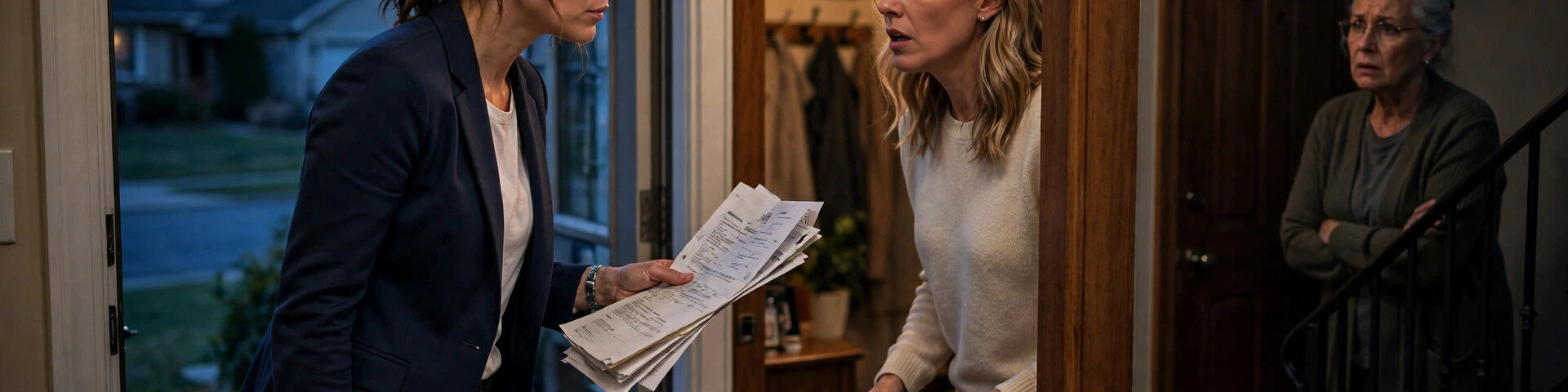
Vanessa opened the front door wearing our mother’s anniversary pearls.
For a moment, that was the only thing I could see. Not the unfamiliar keypad mounted beside the side entrance, its small red light blinking with a cold, mechanical patience. Not the three cars packed along the curb where our quiet street had always held just one. Not the stranger’s work boots resting on the carpeted staircase I had paid to have installed for Mom’s bad knees — thick, mud-caked boots that had no business being inside this house. Just those pearls catching the afternoon light against my sister’s neck, the same small white drops Dad had given Mom on their thirtieth anniversary, the same pair Mom had worn to every Christmas dinner after that, the same pair she had once let me try on when I was twelve and told me I would inherit someday.
Vanessa looked at my suitcase and gave me a smile that made six years of distance feel suddenly deliberate, as though the miles between us had been measured and chosen rather than merely endured. “Oh,” she said. “You’re back.”
No hug. No hand on my shoulder. No question about the twenty-six hours of airports and cramped seats it had taken me to get there, no curiosity about the two layovers or the turbulence over the Pacific that had kept me awake with my forehead against the window.
I tightened my grip on the suitcase handle until my knuckles whitened. “Where’s Mom?”
Vanessa pointed toward the basement door with a casual flick of her wrist, the way someone might gesture toward a laundry room.
“She sleeps downstairs now.”
I stared at her, certain I had misheard.
“What?”
“The upstairs rooms are rented.” She shrugged, as if explaining where someone kept extra towels or which shelf held the good glasses. “Mom contributes too. Five hundred a month. It keeps things fair.”
Behind her, the house looked both familiar and wrong, like a photograph developed with the wrong chemicals. The kitchen walls were the same warm cream I had chosen years earlier, the color I had spent an entire weekend testing in different lights. Dad’s cast-iron skillet still hung above the stove, though it looked duller than I remembered. But a laminated sheet on the refrigerator listed laundry hours and kitchen rules in bold black type, and three upstairs bedroom doors now had small keypad locks — cold, silver squares that turned bedrooms into rental units.
I looked again at the pearls, their soft luster suddenly obscene against my sister’s throat.
Then at my sister.
“You charge Mom rent?”
“She wanted to help.” Vanessa’s tone carried the smooth confidence of someone who had rehearsed this conversation.
“For living in this house? The house I bought?”
Vanessa’s smile thinned at the edges. “Bella, you’ve been gone a long time. A lot has changed.”
That was true.
What she did not know was that some things had not changed at all.
The deed, for one.
The mortgage.
The insurance.
Every property tax payment for the previous six years.
All of them carried one name.
Mine.
I set my suitcase down slowly, the wheels clicking against the hardwood I had once polished on my hands and knees.
“You just made this very easy.”
Vanessa laughed, a short sound with no warmth in it. “Made what easy?”
“You’ll see.”
Six years earlier, I had bought that house for our parents.
I was twenty-nine then and working in restaurant kitchens, the kind where your shift starts before sunrise and ends after everyone else has stopped thinking about dinner. The kind where your hands smell of garlic for days and your feet ache in ways that become so constant you stop noticing. I had spent seven years moving between seasonal resorts, hotel kitchens, and cruise contracts, saving the money other people spent on cars, vacations, furniture, and apartments large enough to impress dates. I lived in staff housing with thin walls and ate staff meals standing up, and I put nearly everything else into an account I rarely touched.
Mom and Dad had rented their entire lives.
Dad, Edward Bird, worked nearly four decades as a machinist. He could hear a lathe making the wrong sound from thirty feet away and knew the tolerance of parts by touch in a way I still cannot explain. His hands were permanently stained with cutting oil, and he wore that like a badge. Mom, Carol, was a seamstress. Brides came to her with dresses three sizes wrong and left believing the dress had always belonged to them. She could look at a woman’s posture and know exactly where the fabric needed to give.
They raised Vanessa and me in duplexes with thin walls, unpredictable landlords, and backyards we were never allowed to change too much because technically nothing was ours. We learned early not to paint walls or plant anything perennial.
Dad never complained.
Mom rarely did.
That made me want to give them something permanent, something no landlord could take back with thirty days’ notice.
In December, I closed on a three-bedroom home on Marigold Court in Westerville. White siding, maple tree out front, narrow backyard, east-facing primary bedroom. It cost just over two hundred thousand dollars. I put sixty thousand down and took a manageable mortgage for the rest — the numbers worked because I had lived like a monk for seven years.
The paperwork was in my name.
Only mine.
Not because I wanted control.
Because I was the one qualifying for the loan, making the down payment, and assuming every financial obligation. My attorney explained the simplest structure and I followed it. There was no scheme in it, no power play — just the cleanest way to make the math work.
I never sat my parents down and explained title theory.
I handed them a key tied with red ribbon on Christmas morning, and watched my father’s face change.
Dad held it in his palm as though it weighed five pounds.
“Bella.”
“Yes?”
“People like us don’t own places like this.”
I smiled through the tears I refused to shed.
“We do now.”
Mom cried in the kitchen, quiet tears that she tried to hide by turning toward the sink.
Dad walked the property line twice before lunch, his hands clasped behind his back, studying every inch of the narrow yard as though memorizing it.
Before they moved in, I painted the largest upstairs bedroom soft yellow because morning light came through its two east windows. Mom always drank tea early, and I wanted her Singer sewing machine where the light was best. I spent three evenings on that paint job, cutting in the edges with the careful patience I had learned from watching Mom sew.
I also paid to carpet the main staircase.
Her knees had already started bothering her — I had seen her grip the railing on the duplex stairs.
“A seamstress needs real light,” I told her when I set the machine near the window.
She ran one hand over its metal case and said nothing for a while, her fingers tracing the familiar curves.
That was enough. That silence held everything.
Three months later, I accepted an executive sous-chef position in Queenstown, New Zealand.
It was supposed to last two years.
It lasted six.
Before leaving, I put everything on autopay.
Mortgage. Insurance. Taxes through escrow. Utilities. Home warranty.
Even the quarterly pest service.
Money left my account quietly every month while I stood twelve thousand miles away breaking down salmon, writing staff schedules, correcting food costs, and telling myself paying bills was one form of presence. I checked the account every month like a ritual, confirming each payment had cleared, and each confirmation felt like a small proof that I was still taking care of them even from the other side of the world.
The night before I flew out, Dad called.
He talked about tomatoes — the varieties he planned to plant, the soil amendments he was considering, the eternal debate about staking versus caging.
Then he said something I laughed at.
“Keep an eye on your sister.”
“Vanessa?”
“She counts other people’s plates.”
“What does that even mean?”
“You’ll understand when you understand.”
I laughed, the easy laugh of someone who thinks they have time to understand things later.
That was the last long conversation we ever had.