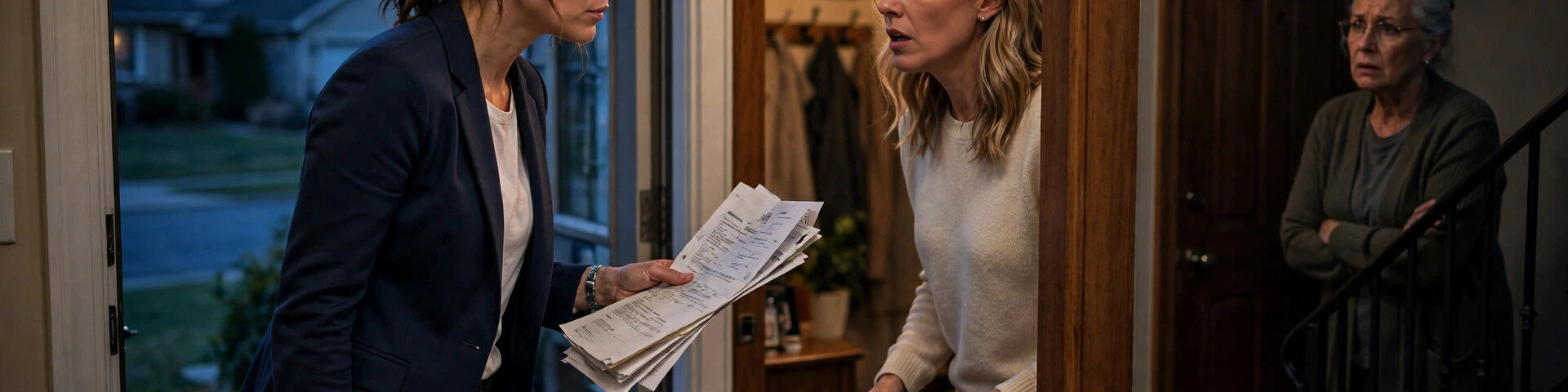
I looked at Mom, the notebook suddenly heavy as stone in my hands.
“What is this?”
“My contribution.” She said it with quiet dignity.
“To what?”
“The house.”
“What part of the house?”
She frowned, as though the question were strange.
“The mortgage. Taxes. Everything.”
My hands went cold, the blood retreating from my fingers.
“Who told you I couldn’t cover the mortgage?”
“Bella.” She touched my wrist gently. “You shouldn’t be embarrassed.”
“I’m not embarrassed.”
“Vanessa explained.”
“Explained what?”
“That you send what you can from overseas. She handles the rest.”
I stared at the notebook, at forty-eight identical entries, at four years of my mother’s faithful payments toward a debt that did not exist.
“All of it?”
“Yes.”
Mom almost smiled, proud of her consistency.
“I’m never late.”
That was the line that hurt most.
Not the amount.
Not Vanessa.
The pride — my mother’s fierce, lifelong pride in meeting her obligations, twisted into an instrument against her.
My mother had spent her life paying every obligation exactly when due. She balanced her checkbook to the penny. She mailed utility payments days early because she considered due dates unnecessarily risky. She had once driven to the electric company in a snowstorm because she didn’t trust the mail.
Someone had taken that part of her — the best part — and turned it against her.
“How do you pay?”
“I walk to the bank.” She said it simply, as though describing a pleasant routine.
“Cash?”
“Yes.”
“Then what?”
“I give it to Vanessa.”
“Every month?”
Mom looked almost offended by the question.
“Of course.”
I locked my face into something calm, though fury was building behind my ribs like pressure in a sealed pot.
My phone held seventy-six mortgage confirmations.
Every one from my account.
Every one paid on time, in full, for six years.
I could have shown her immediately.
Instead, I asked, keeping my voice gentle:
“Tell me about the people upstairs.”
That was how I learned their names.
Douglas in the front room.
Machine operator.
Quiet.
Helpful — the kind of man who fixes things without being asked.
Cole in the blue room.
Line cook.
Works early, comes home smelling of fryer oil and exhaustion.
Dana in Dad’s office.
Hospital employee.
Night shifts, sleeping days in the room where my father once did his crosswords.
Mom spoke about each kindly, with genuine warmth — these were people she lived with, after all, people whose laundry hummed through the walls.
Douglas fixed a loose stair rail without being asked.
Cole brought bakery bread home after Sunday prep, still warm in the bag.
Dana helped Mom order a prescription online, patiently explaining each step.
Not one bitter word about any of them. My mother, sleeping on a cot in the basement, held no resentment toward the strangers in her bedrooms.
“What do they think your arrangement is?”
Mom blinked, confused.
“What do you mean?”
“Why do they think you live downstairs?”
She rotated her wedding ring slowly around her finger, a habit from decades of thinking.
“I suppose Vanessa explained.”
That answer became a theme, a refrain I would hear again and again.
Vanessa explained.
The next evidence arrived that night, unplanned and illuminating.
The keypad battery died and two tenants had to knock at the front door, looking sheepish in the porch light.
Vanessa let them in before leaving for dinner again, her heels clicking toward her waiting ride.
I stayed at the kitchen table, nursing a cup of tea I didn’t want.
Douglas saw me first.
“You’re Isabella.”
Not a question — a statement of recognition.
I nodded.
“The daughter overseas.”
His sentence stopped there, hanging unfinished.
“Finish it.”
He looked uncomfortable, glancing at Cole.
Then sat when I gestured to the chair across from me.
Cole remained standing beside him in kitchen clogs, arms crossed.
Douglas said, choosing his words carefully:
“Vanessa told us Carol had some memory trouble.”
I stared, the tea suddenly bitter on my tongue.
“She said the basement was easier to monitor.”
Cole added quietly, not meeting my eyes: “We thought it was medical.”
“My mother is not experiencing serious memory problems.” My voice was flat, controlled.
Both men looked genuinely surprised — and then ashamed.
Douglas rubbed his jaw, a gesture of distress.
“She remembers every measurement when she fixes my work pants.” He looked at me directly. “Every single one.”
I almost smiled despite everything.
“Exactly.”
I asked one question, the one that mattered most.
“How do you pay rent?”
Douglas took out his phone, scrolling with practiced ease.
Fifty-one electronic payments.
Nine hundred fifty dollars each.
Recipient: V. BIRD.
Front Room.
Cole had similar records on his own phone.
Neither man had any idea Vanessa did not own the house. They had signed agreements, paid deposits, received receipts — all from a woman with no legal right to any of it.
“She told us it was hers,” Douglas said quietly.
“What about me?”
He hesitated, clearly reluctant.
“She said you helped occasionally. Sent money when you could.”
I nodded slowly, absorbing the completeness of the fiction.
That was enough for that night.
“You did nothing wrong.” I looked at both of them steadily.
Douglas looked toward the basement door, his expression troubled.
“I should’ve asked more questions.”
“You were given a story — a complete, consistent story.”
He sighed heavily.
“Still.”
There was decency in that single word, in his unwillingness to let himself off easy.
I asked them not to discuss the conversation yet.
They agreed, both nodding solemnly.
Vanessa came home later and found the three of us at the table, the atmosphere thick with unspoken things.
Her eyes flicked toward Douglas’s phone, then to the closed notebook beside my elbow.
“What’s this?” “Conversation.” She smiled, but it didn’t reach her eyes. “About?” “Work.” Cole said nothing, studying his hands.
Vanessa looked at me longer than necessary, searching my face for what I knew.
Then wished everyone good night with artificial brightness and disappeared upstairs.
Through the wall, I heard her on the phone later, her voice carrying in the quiet house.
One sentence carried clearly through the drywall.
“Let her ask questions.”
She sounded confident, almost amused.
That was useful. Overconfidence makes people careless.
The next morning, I went across the street to meet Rosemary Ellis, who had lived there for decades and knew everything about everyone.
I carried banana bread, warm from the oven — I had gotten up early to bake, needing something to do with my hands.
Older neighbors will tell you history faster if you bring carbohydrates. It’s practically a law of nature.
Rosemary hugged me tightly, her eyes wet.
Three minutes later, over coffee at her kitchen table, she told me Vanessa had “done such a wonderful job taking over the house.”
Taking over.
The phrase landed like a stone in still water.
“What do you mean?”
“Well, after your father passed.” Rosemary lowered her voice conspiratorially. “Your mother had to move downstairs for medical reasons.”
“Who said that?”
“Vanessa.”
“Medical reasons?”
“The stairs, you know.” She gestured vaguely. “The doctor supposedly didn’t want Carol going upstairs anymore.”
I looked back toward the house across the street.
The basement steps were steeper than the carpeted main staircase — narrow, wooden, treacherous. Anyone claiming the basement was safer than the carpeted stairs was either lying or delusional.
Rosemary continued, oblivious to my expression.
“The doctor supposedly didn’t want Carol going upstairs.”
My stomach tightened into a hard knot.
“What does the neighborhood think about ownership?”
Rosemary laughed, a comfortable sound.
“That Vanessa inherited it eventually, of course. After your father, you know.”
“Inherited from who?”
She stared at me, her smile faltering.
Then her expression shifted as understanding dawned.
“Oh.”
I smiled reassuringly.
“It’s okay.”
“No, honey.” She lowered her voice to a whisper. “She tells everyone it’s effectively hers because she takes care of your mother. That she’s the one who stepped up.”
There it was.
Different audience.
Different story.
Tenants heard medical confusion — a mother losing her grip, needing supervision.
Neighbors heard doctor’s orders — a professional recommendation, unquestionable.
Mom heard financial necessity — a daughter overseas who couldn’t quite manage, a gap that needed filling.
I had heard everything was fine — regular calls, cheerful updates, nothing to worry about.
Every version served the same person. Every story positioned Vanessa as the hero and everyone else as either helpless or absent.
That afternoon, I took Mom to the bank, driving her in my rental car while she sat quietly beside me.
We printed statements — the teller was kind, not asking why an elderly woman needed four years of records.
Forty-eight withdrawals.
Five hundred dollars.
Dates matching the notebook exactly, each one a small monument to my mother’s diligence.
Then I noticed a seventy-dollar prescription had not been filled one month — a gap in the pattern.
“Why didn’t you get this medication?”
Mom looked out the car window at the parking lot, her profile still.
“It was expensive.”
“Seventy dollars.”
“That month was tight.”
“For you?”
“For the house.”
I remembered seeing Vanessa’s social-media pictures from a weekend trip that same month — smiling on a beach, cocktail in hand, the picture-perfect life.
I did not show Mom. Not yet. The time wasn’t right.
I asked another question, the one that had been burning in me.
“Why did you stop messaging me directly?”
Her hand tightened around her purse until her knuckles showed white.
“I didn’t want to bother you.”
“You never bothered me. Not once. Not ever.”
“She showed me.” I went still. “Who?” “Vanessa.” “Showed you what?” Mom looked ashamed, her eyes dropping to her lap.
That hurt before I even knew why — the shame on her face for something she hadn’t done.
That evening, she sat beside me on the living-room couch and removed a folded sheet from her purse with shaking hands.
The paper had been opened so many times the creases felt like cloth, soft and worn.
It was a printed screenshot of a text exchange.
At the top appeared my old Ohio phone number, the one I had carried for a decade.
One message supposedly from me read:
I’m exhausted. I can’t carry Mom too. Please don’t tell her I said that.
I read it twice, my vision blurring.
Then looked at Mom, at the pain etched into the lines around her eyes.
“How long have you had this?”
“Four years.” Her voice was barely audible.
My voice nearly failed me.
“Mom.”
“Vanessa didn’t want to show me.” She said that defensively, as though protecting my sister even now. “I kept asking why you didn’t want me visiting. She finally showed me because she said you needed space.”
I looked at the number at the top of the screenshot.
Then opened my email on my phone, my fingers steady with a cold fury.
Searched old carrier messages.
Found the account-closure confirmation, the email I had barely glanced at years ago.
Dated more than two years before the supposed conversation.
I turned the screen toward her.
“Look at the date.”
Mom read, her lips moving silently.
Then the printed text.
Then the email again, her brow furrowing.
“That number stopped working?”
“Yes.”
“When?”
I pointed to the closure date.
Her face slowly changed as understanding crept in — the particular expression of someone watching a trusted structure collapse.
“This message says it came from that number two years later.”
“Yes.”
She looked at me, her eyes wide and wounded.
“Did you write it somewhere else? Another phone?”
“No.”
“Did you ever tell Vanessa I was a burden? Even once, when you were tired?”
“Never. Not in words, not in thought, not for a single second.”
Mom sat very still, the screenshot trembling in her hands.
Then asked the question I deserved, the one I had been dreading.
“Why didn’t you come home?”
That one belonged to me. No one else could answer it.
I could have blamed borders.
Contracts.
Work.
Airfare.
For part of the time, those things were true — the pandemic had made travel genuinely difficult, and my contract had real obligations.
Not for all of it. Not for the last two years, when the world had reopened and I had simply… stayed.
“I made staying away easy.” The confession tasted like ash.
She listened, her face unreadable.
“I paid everything automatically. I called on schedule. I sent money. I told myself that counted as being here — that the transfers were a form of presence.”
Tears filled my eyes, hot and sudden.
“It didn’t. I know that now.”
Mom looked down at her hands.
“I told you not to come.”
“I know.”
“I thought I was protecting your life — your career, your future.”
“And I let you, because it was easier than facing what I was avoiding.”
We sat in silence, the weight of mutual protection settling around us.
Two women who had been protecting each other from a burden neither actually considered the other to be — a tragic comedy of love expressed through absence.
Then Mom remembered something, her expression shifting.
“The phone.”
“What?”
“Vanessa gave me a new phone that summer.” She frowned, reconstructing the memory. “She set it up for me. Said the old one was too complicated.”
My New Zealand number had never been added to the contacts.
Every later video call had been routed through Vanessa — she would call me, then hand the phone to Mom, then take it back.
Mom had not noticed because Vanessa would simply hand her a device and say: “Bella’s calling.” The same kitchen corner. The same camera angle. The same beige wall behind her. Four years of conversations passed through one person before reaching either end, four years of filtered love.
I finally understood why I had never seen the basement.
Why Mom never walked while we talked, never gave me a tour of the house.
Why every call happened from the same place, the same chair, the same wall.
The next morning, I went to the county recorder’s public portal and printed the deed.
Then the closing documents.
Then years of mortgage statements, page after page of proof.
Then my property-tax records.
I printed everything at the library, the old printer humming.
Ten cents a page.
Truth was cheap.
The deception surrounding it had cost much more — four years, twenty-four thousand dollars, and pieces of my mother’s spirit I wasn’t sure I could restore.
The deed showed one owner.
Isabella Bird.
The mortgage showed one borrower.
Isabella Bird.
Seventy-six consecutive payments.
One account.
Mine.
I added Mom’s bank statements, the pages crisp and official.
Her notebook, the spiral binding catching the light.
The carrier closure notice with its damning date.
The impossible text screenshot, its lie now exposed.
A clean file, organized chronologically.
Not revenge.
Evidence. There is a difference, and it mattered to me.