Vanessa announced Mom’s sixty-sixth birthday dinner for Sunday.
Family only.
That was almost funny, given the three strangers living upstairs.
She invited our aunt Judith, who had been staying upstairs for months without paying rent, Rosemary from across the street, her boyfriend Shane, and several relatives — a curated guest list designed to showcase her role as the devoted daughter.
Before dinner, I met Douglas privately in the driveway, away from the house.
I showed him the deed, watching his face as he read.
He read every line carefully, his finger tracing the text.
Then sat back on the garden wall, the paper trembling slightly in his hands.
“Four years.”
“Yes.”
“I paid rent to someone who didn’t own the house. For four years.”
“Yes.”
He looked embarrassed, his weathered face flushing.
“This isn’t your fault.” I meant it.
He shook his head slowly.
“Carol fixed my collar before a job interview. Sat me down and wouldn’t let me leave until it was perfect.” His voice thickened. “She sat downstairs while I slept in her bedroom — her bedroom, the one with the morning light.”
His voice became rough with emotion.
“I don’t like that. I don’t like that at all.”
“Neither do I.”
I asked him to come to Mom’s birthday at one o’clock if he was comfortable — no pressure, no obligation.
No performance.
No speech.
Only his own records if questions arose. Just the truth, spoken simply.
He agreed, folding the deed copy I gave him with care.
I did not coach Mom.
That mattered more than anything else I did. Whatever happened at that table had to be hers — her questions, her conclusions, her choice.
Saturday night, I sat beside her in the basement, on the edge of the cot that had been her bed for four years.
“What do you want tomorrow?”
She thought a long time, her hands folded in her lap, her silver hair catching the lamplight.
Then said, quietly:
“I want to ask Vanessa one question.”
“What question?”
She looked at me directly, her eyes clear and steady.
“I’ll know it when I say it.”
Fair enough. I trusted her.
Sunday arrived with bakery cake, white flowers, and too many photographs — Vanessa had staged it beautifully, the perfect family celebration.
Vanessa sat at the head of the table, the position of honor she had claimed.
Mom sat near the side, slightly removed from the center — a placement I noticed, and I saw Douglas notice it too.
We all did eventually. The seating chart told its own story.
Dinner went smoothly at first, the kind of smooth that feels rehearsed.
Shane complimented the food with the enthusiasm of someone trying hard to belong.
Rosemary brought rolls, her eyes darting between Vanessa and me.
Judith told a story about Dad, her voice wobbling with what might have been genuine emotion.
Then Vanessa raised her glass, the crystal catching the light.
“For five years,” she said, her voice warm and practiced, “I’ve done everything I could to keep Mom secure in this house.”
Mom’s hand found mine beneath the table, her fingers cold.
Vanessa continued, oblivious or indifferent to the tension building around her.
“She’ll never be alone as long as I’m here.”
A few people nodded, moved by the sentiment.
Then Vanessa reached toward a folder beside her chair with a casualness that didn’t fool me.
“And since everyone’s together, Mom, I thought we should finally organize the house paperwork.”
I leaned forward. “What paperwork?” “Just future planning.” She smiled, the picture of reasonableness. “Nothing dramatic.”
She removed a prepared form from the folder, smoothing it on the table.
A transfer-on-death document — the kind that would have given her legal claim to the house upon Mom’s death, a document Mom had no authority to sign for property she didn’t own.
The room changed slightly, a subtle shift in atmosphere.
Not enough.
Not yet.
I touched my spoon to my glass.
One clear note rang out, silencing the table.
“Before that, I have a birthday present.”
Vanessa looked at me, her composure flickering.
“It’s paperwork too.”
I placed Mom’s spiral notebook in the center of the table, its worn cover facing up.
Vanessa’s expression barely moved, but I saw her fingers tighten on her wine glass.
“Mom,” I said gently, “how much have you contributed every month?”
Mom looked at the notebook, then at the faces around the table.
“Five hundred.”
“For how long?”
“Four years.”
I turned toward Vanessa, my voice calm and clear.
“What is the monthly mortgage payment?”
She answered confidently, the numbers rolling off her tongue.
“Around two thousand with taxes and everything.”
I did not correct her immediately.
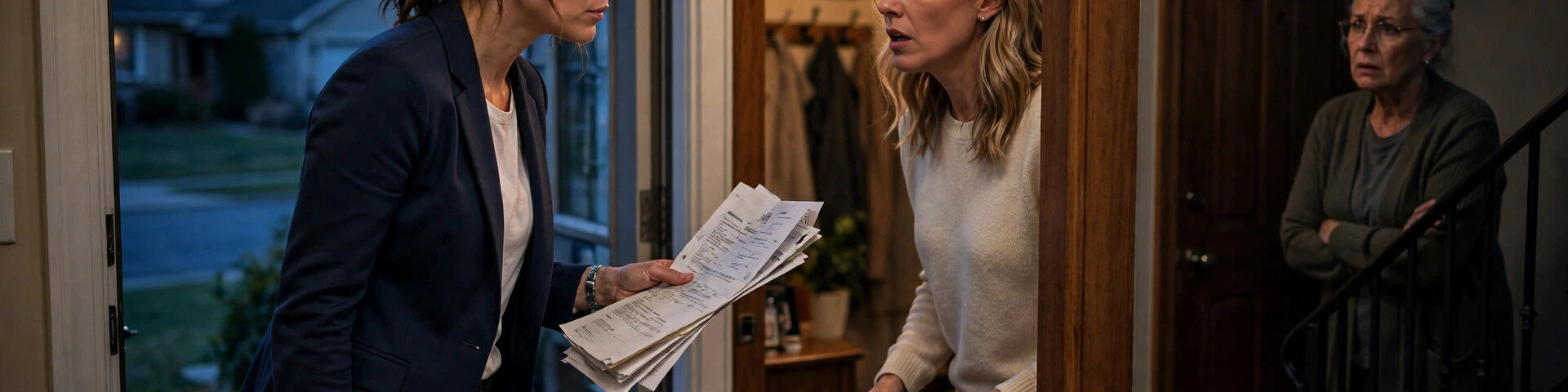
Instead, I opened the file I had prepared — the thick folder of evidence.
Placed the first mortgage statement beside the notebook with deliberate care.
Then another. Then another, each one landing with a soft slap on the tablecloth.
“Eleven eighty.” Vanessa’s smile disappeared. “What?” “The mortgage payment — eleven hundred and eighty dollars, not two thousand.”
I pushed the top statement toward Shane, who read it with growing confusion.
“Account holder?” He read aloud. “Isabella Bird.” Another statement. Another month. Same amount. Same borrower. Same name, over and over.
I placed the stack on the table — seventy-six statements, a small tower of truth.
“Seventy-six payments.”
The room went quiet, the kind of silence that has weight.
“Mortgage, taxes, insurance. Paid from my account every month since I bought this property. Every single month for six years.”
Vanessa leaned back in her chair, her face carefully blank.
“Bella.”
I continued, my voice steady.
“There was never a second mortgage Mom needed to help carry.”
Nothing. No response.
“There was never a gap you were filling.”
Nothing. The silence stretched.
“Mom’s twenty-four thousand dollars did not go toward my loan. It went —” I paused, looking directly at my sister, “— somewhere else.”
Rosemary’s hand moved toward her mouth.
Judith looked down at her plate.
Vanessa stood abruptly, her chair scraping against the floor.
“So now you come home after six years and decide to audit everybody?”
Her voice remained controlled, but I could see the effort it cost her.
That was my sister. She did not panic easily. She had always been the composed one, the planner.
“I stayed.” She looked around the table, gathering allies. “I was here when Dad died.”
That landed, because it was true — undeniably, painfully true.
“I drove Mom to appointments.” Also true. “I handled groceries.” True. “I managed this house while Bella lived on the other side of the world.” True, true, true.
“You want numbers? Fine. What number do you put on five years of caretaking? What’s the dollar value of being here?”
Nobody answered. The question hung in the air, legitimate and unanswerable.
Vanessa’s eyes returned to me, blazing.
“You paid a mortgage from paradise. I paid with my life — my time, my energy, my youth.”
The room held its breath.
That was her best argument, and it hurt because part of it belonged to reality. I had left. I had mistaken paying for presence. I had built a comfortable life twelve thousand miles away while she dealt with the daily reality.
I did not deny it. Denial would have been dishonest.
“You were here.”
I nodded slowly.
“I wasn’t.”
Vanessa’s mouth softened toward victory, the first hint of triumph crossing her face.
Then I unfolded the fake message — the printed screenshot, its creases soft as cloth.
“But being here did not give you permission to create this.”
I placed it beside the mortgage statements with the same deliberate care.
Mom’s face tightened, her hands gripping the edge of the table.
I continued, my voice gentle but unyielding.
“This is the message Mom has carried for four years — folded in her purse, reread countless times, believed completely.”
Shane read it, his expression darkening.
Judith leaned closer, her reading glasses perched on her nose.
“According to this, I told Vanessa that I was tired of carrying Mom. That I was exhausted and couldn’t do it anymore.”
Vanessa said, her voice tight: “You sent that.”
“No.”
“You did. I have the screenshot.”
I placed the carrier closure notice beside it — the email with its devastating date.
“That number was disconnected more than two years before this supposed conversation. The account was closed. The number was dead.”
Silence. Absolute, ringing silence.
“The account closure date is here.” I tapped the email. “The screenshot is dated here.” Another tap, the paper rustling. “Explain how a dead number sent a message twenty-seven months after it was closed. Explain the technology that allows that.”
Vanessa stared at the two documents, her mind visibly racing for an explanation.
Then said, weakly: “Phones can—”
“No.” I did not raise my voice, but the single word carried the force of a shout. “Don’t make Mom sit through another explanation that requires her to doubt what she can read with her own eyes. She’s done enough of that.”
That stopped her. The fight went out of her shoulders.
Then someone knocked on the front door.
Exactly one o’clock — Douglas was punctual, as I had hoped.
Douglas entered holding his cap in both hands, his work-worn face solemn.
“Happy birthday, Mrs. Bird.”
Mom smiled despite everything, genuine warmth breaking through the tension.
“Thank you, Douglas.”
He placed his room key on the table — a small, symbolic gesture.
Then his phone, screen glowing with his banking app.
Payment history.
Fifty-one rent transfers, each one documented.
Each to Vanessa.
Nine hundred fifty dollars. Every month. For over four years.
Douglas spoke simply, his voice steady and clear.
“I rented the front room for four years.”
He looked toward Mom with something like shame in his eyes.
“I was told Mrs. Bird had trouble navigating the house at night and that the basement arrangement was for convenience — for her safety.”
Mom stared, her mouth slightly open.
Douglas continued, his voice growing stronger.
“I was also told Vanessa owned the property. That she had inherited it and was managing it.”
Rosemary spoke up from her end of the table, her voice shaking slightly.
“She told the neighborhood Carol’s doctor recommended no upstairs rooms. That it was a medical necessity.”
Everyone looked at the main staircase — carpeted, gentle, safe.
Then toward the basement door — bare wooden steps, steep and unforgiving.
Rosemary’s voice softened with dawning horror.
“And we were told the house would pass to Vanessa because she had taken over everything — that it was only a matter of time and paperwork.”
Vanessa looked around the table wildly.
For the first time, every version she had created occupied one room, colliding and contradicting. Tenant version. Neighbor version. Mom’s financial version. My overseas version. None of them matched. None of them could survive contact with each other.
I took out the deed — a single page, crisp and official.
One page.
That was the evidence object that changed the room most completely. Not the stack of statements, not the fake message, not Douglas’s testimony. One page with one name.
I placed it on the table in the center, where everyone could see.
“Current owner.”
Shane leaned closer, squinting at the legal text.
“Isabella Bird.”
Vanessa looked at the document, then at me, her face pale.
“You bought it for Mom and Dad.”
“Yes.”
“So it’s a family house. It belongs to all of us.”
“It is Mom’s home — she will always have a home here.”
I kept my voice calm, though my heart was pounding.
“But legal ownership has never changed. Not for one day.”
“You were going to give it to them eventually.”
“No.” I shook my head. “I gave them permanent use while I carried the financial responsibility. That was the arrangement. That was the gift.”
She folded her arms defensively.
“That’s semantics. You’re playing with words.”
“No.”
I tapped the deed with one finger.
“That’s title. That’s law. That’s not semantics.”
Mom stood.
That ended the argument more effectively than anything I could have said. The room fell silent as she rose, her movements deliberate and dignified.
She smoothed her blouse with both hands.
Then looked at Vanessa directly, her silver hair catching the afternoon light from the window.
“Did Bella ever tell you I was a burden?”
Vanessa froze, her mouth opening and closing soundlessly.
Mom repeated, her voice stronger: “Ever. Did she ever, even once, say I was too much?”
Silence. Thick, absolute silence.
“Yes or no, Vanessa.”
Vanessa looked toward Judith, seeking support.
Then Shane. Then the table, the floor, anywhere but Mom’s eyes.
“No.” The word came out as barely a whisper. Mom nodded once. “Thank you.”
No speech. No screaming. No dramatic denunciation.
Then she held out her hand, palm up, steady as stone.
Vanessa stared at the outstretched hand, uncomprehending.
Mom’s eyes moved deliberately to the pearls at Vanessa’s throat.
My sister’s fingers rose slowly to her ears, trembling.
One pearl earring.
Then the other.
She placed them into Mom’s palm — Dad’s anniversary gift, returned at last.
Mom closed her fingers around them gently.
“I’d like you to stay somewhere else tonight.”
Vanessa’s face changed, the last of her composure cracking.
“Mom. Please.”
“I’m not putting you out with no time for your belongings.” Her voice remained calm, almost kind. “You can arrange pickups with Bella. We’ll be reasonable about it.”
Then she looked around the house — her home, the place she had been made to feel like a guest.
“And I want my bedroom back.”
That was the reversal. The true turning point.
Not the deed.
Not Vanessa losing composure.
Mom asking for her room. Her own room. The yellow one with morning light, the one I had painted for her with such love.
Vanessa left that evening with two suitcases, packed hastily.
Shane drove, his face grim, not meeting anyone’s eyes.
At the front door, she looked at me — really looked at me — for the first time that day.
“You humiliated me. In front of everyone.”
“No.” I shook my head slowly. “We put everyone who had been told different stories in one room. That’s all. The truth did the rest.”
She stared at me for a long moment.
“That’s all.”
The door closed with a soft click that somehow sounded final.