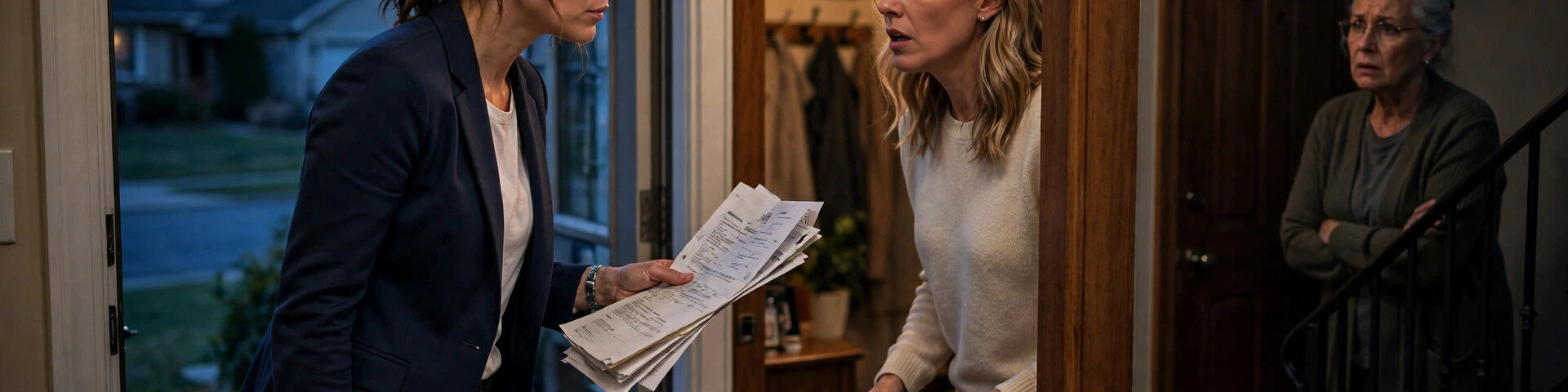
Monday morning, I hired a locksmith — not for drama, but for clarity.
Not because I wanted spectacle.
Because security needed to be clear, boundaries needed to be physical as well as verbal.
Vanessa received scheduled access to collect her remaining belongings — specific times, supervised, documented.
Everything documented.
Everything calm, professional, without scene or shouting.
The tenants stayed temporarily. They had been misled too — victims of the same fictions, paying rent in good faith to someone who had no right to collect it.
Douglas and Dana signed month-to-month agreements directly with me while we worked out longer-term arrangements. Rent went into a separate property account, clean and transparent. A portion funded maintenance — the house had suffered from years of Vanessa’s management, and there was much to repair.
Mom chose how the household functioned because even though the deed said my name, I finally understood something I should have understood six years earlier.
Ownership was not the same as presence.
I had bought a house.
Mom had lived a life inside it — had made it a home through daily acts of care invisible to me from twelve thousand miles away.
Both mattered. I had been wrong to think only one did.
Cole, the line cook, turned out to be an excellent prep cook — I discovered this when I watched him work during a trial shift.
I had already accepted an executive-chef position at a restaurant in Columbus for my return home. When we needed someone for morning prep, I asked him to interview properly, like anyone else.
He earned the position himself.
No favors.
No shortcuts because of our history.
He was good.
Very good — his knife work was precise, his palate reliable, his work ethic solid.
The stranger occupying Mom’s yellow room was Dana.
When she learned what had happened — the full story, which I told her honestly — she came home after a night shift still in scrubs, her face drawn with guilt.
“I can move today. Right now. I’ll pack my things.”
“You don’t have to leave the house today.”
“I know.” She looked toward the stairs, toward the yellow room. “I mean the room. I’ll get out of her room today.”
By that evening, she had transferred her belongings into the smaller blue bedroom, working quietly and efficiently.
She stood in the yellow room afterward and smiled at Mom, gesturing at the morning light streaming through the east windows.
“Too much sunlight in here anyway. I’m a night-shift person — I need a cave.”
Mom laughed — a real laugh, the first I had heard in days.
So did I, the tension breaking like a fever.
Two days later, we moved her back upstairs — a small procession of care.
Douglas carried boxes, his strong arms making easy work of them.
Cole carried the sewing table, navigating the stairs with practiced balance.
I carried the old Singer myself, cradling it like something precious — because it was.
The cot stayed in the basement, folded and put away.
Mom’s winter clothes returned to the closet, hung with care.
Her cookbooks came back to the kitchen, arranged on the shelf I had built years ago.
Her church calendar replaced the laminated tenant schedule on the refrigerator — a small rectangle of normalcy reclaiming its place.
Then we placed the Singer beside the east window.
Exactly where I had set it years earlier, in the pool of morning light.
Mom touched the machine with reverent fingers.
“A seamstress needs real light.”
I had said those words before leaving, six years ago, in this same room.
Hearing them back nearly undid me — the circle completing, the promise kept too late but kept nonetheless.
That afternoon, while unpacking a box of old books, I found an envelope tucked between the pages of a cookbook.
BELLA.
Dad’s handwriting — block letters, machinist handwriting, each letter formed with deliberate precision.
He had apparently written it years earlier and never mailed it, perhaps waiting for the right moment that never came.
The note was short, in his economical style.
He thanked me for the house — straightforward, no fuss.
Complained about the maple tree, which was already growing too fast for his liking.
Said he planned to trim it in spring, a project he never got to complete.
Then at the bottom, underlined twice:
LOOK AFTER YOUR MOTHER. NOT WITH MONEY. SHE HAS NEVER CARED MUCH ABOUT MONEY.
I sat on the yellow-room floor and cried — deep, shaking sobs I had held back for years.
Finally.
Not over Vanessa, though heaven knows there was grief there too.
Over Dad — his voice in those block letters, his wisdom arriving years too late and exactly on time.
Over six years of absence I could never reclaim.
Over every autopay transaction I had used as evidence that I was doing enough, each confirmation email a small lie I told myself.
Money had kept the roof intact.
It had not noticed Mom sleeping beneath it on a folding cot.
The next thing I did was return Mom’s twenty-four thousand dollars — every cent, with interest I calculated myself.
She refused, her jaw set in the particular stubbornness I had inherited.
“I paid willingly. It was my choice.”
“You paid under false information. You were deceived about why.”
“I still gave it. The giving was real.”
“Mom.”
“No. I won’t take it back.”
We argued — a real argument, the kind we used to have about important things.
Then I used the only strategy that had worked on Carol Bird my entire life.
Arithmetic. Cold, irrefutable numbers.
“You have never left anyone unpaid. Not once in your life.”
She narrowed her eyes, sensing a trap.
“That’s different. This is family.”
“If I keep money you paid toward a mortgage I already covered, then I owe you twenty-four thousand dollars. That’s a debt on my books.”
“You do not.”
“Then let me clear the balance. Let my books be clean.”
She stared at me for a long moment.
Then laughed — the real laugh, deep and surprised.
I transferred the money into her retirement account that same afternoon, watching the confirmation appear on screen.
Afterward, she brought me the spiral notebook — the record of four years of faithful payments.
I turned past forty-eight entries, each one in her careful hand.
On line forty-nine, I wrote in my own bold script:
PAID IN FULL. CAROL BIRD NEVER OWED THIS HOUSE ANYTHING.
Mom read it, her lips moving silently.
Closed the notebook.
Then put it into the deep drawer of her sewing table where she kept important patterns — the things too precious to lose.
A week later, Mom and I visited Dad’s grave together, driving out on a clear morning.
She wore the anniversary pearls.
Both earrings — I had found the mate to a second pair she thought was lost years earlier among Vanessa’s stored belongings during a scheduled pickup. Mom did not ask how it got there. I did not need another confrontation. Some things are better left unexamined.
At the cemetery, Mom talked to Dad as though he were sitting across from the kitchen table, her voice conversational and warm.
She told him everything.
The basement. The rent. The notebook. The fake message. Vanessa. Me coming home. No softening, no editing — the full, unvarnished truth.
My mother never knew how to tell a partial truth. It simply wasn’t in her nature.
At the end, she touched the pearls at her throat.
Then said, clearly:
“And I decide who I see now, Ed.”
She smiled — a small, fierce smile.
“Me.”
One syllable.
It carried years of reclaimed authority.
Aunt Judith remained another problem to solve.
She had been occupying one upstairs bedroom without paying anything — a freeloader in the house of cards Vanessa had built.
At first, she claimed she knew nothing, her eyes wide with practiced innocence.
Then during a conversation over coffee, she accidentally admitted seeing Mom’s payment notebook two months earlier — the detail slipped out before she could catch it.
Mom stared at her sister.
“You saw it?”
Judith went pale, her coffee cup rattling against its saucer.
“I didn’t understand what I was looking at.”
“You understood enough to feel bad about it.”
Silence. The kind that confirms everything.
That was enough — Mom didn’t need more.
Mom surprised me with her response. I had expected fury, or tears, or immediate expulsion.
She did not throw her sister out immediately.
“You have six weeks.” Her voice was calm, final.
Judith began crying, great heaving sobs.
Mom lifted one finger, and the crying stuttered to a stop.
“I will not put my sixty-three-year-old sister out with nowhere to go. I’m not cruel.”
Then, her voice hardening:
“But you will pay fair rent until you leave. Market rate, in writing.”
Another finger.
“And you will correct the things you repeated about Bella — to everyone you told.”
Judith stared, tears drying on her cheeks.
“What things?”
Mom’s eyes hardened to flint.
“That she abandoned me. That she didn’t care. That she left me here alone.”
Judith looked down at her hands.
Mom continued, relentless: “You knew enough to repeat the story. Now you know enough to correct it. Every person, every conversation.”
She did. At church. To neighbors. To relatives. Not perfectly — some conversations were harder than others. Enough. The narrative began to shift, slowly, like a large ship turning.
The quieter work afterward mattered more than the birthday confrontation — the daily rebuilding, the small consistencies.
I stayed.
That was my part. Not money, not paperwork, not evidence. Presence.
I accepted the Columbus job permanently — twenty minutes from Marigold Court, close enough to be there for dinner, far enough to have my own life.
I moved into the small blue bedroom after Dana eventually found an apartment closer to work — a practical arrangement that felt right.
Not the yellow room.
Never that room. That room was Mom’s, now and always.
Sunday dinner became nonnegotiable — not a suggestion but a sacred appointment.
Not because Mom needed supervision.
Because I finally understood presents cannot be automated. Neither can presence. You cannot autopay your way into someone’s life.
I cooked — real food, the kind that takes time.
She sewed, her machine humming upstairs in the good light.
Sometimes Douglas stopped by, bringing stories from his new condo.
Sometimes Cole brought bread, still warm from the restaurant ovens.
Sometimes nobody came and Mom and I ate eggs from Dad’s skillet while arguing about whether I used too much salt — the comfortable bickering of people who belong to each other.
Vanessa remained away for several months. The silence between us was complete.
Her first message was angry — defensive, accusatory, rewriting history.
Her second was shorter. Less certain.
The third said, simply:
I don’t know how to explain what I did without making excuses.
I did not answer immediately. I let the message sit, giving it the weight it deserved.
A week later, she wrote again, longer this time:
I told myself I was carrying everything because Bella left. Then after a while, I started believing anything I did was justified because I stayed. I told myself the money didn’t matter, that Mom was fine, that you didn’t care enough to check. I built a whole world out of those lies.
That was closer to truth. I recognized the painful honesty in it.
I showed Mom. She read it twice, her expression unreadable.
She sat with the message for a long time.
Then said, quietly:
“I don’t want to see her yet.”
“Okay.” No pressure. No timeline. Her healing would move at her own pace.
Weeks passed. The seasons began to turn.
Then Mom called Vanessa herself — I wasn’t there, and she didn’t tell me until afterward.
A short conversation.
Ten minutes. Just the two of them.
She did not invite her home.
That came later. Several months later. Daytime. Two hours. No keys. No assumption of anything beyond those two hours.
When Vanessa arrived, she looked smaller somehow.
Not physically — she was the same height, the same build.
Less certain. The confidence that had once filled rooms had been replaced by something quieter, more careful.
She sat at the kitchen table where she once collected Mom’s five hundred dollars every month — the same table, the same chair, a completely different woman.
Mom placed the spiral notebook between them, its worn cover facing up.
Vanessa stared at it, at forty-eight entries in Mom’s hand.
“I’m sorry.” Mom waited, giving her space. “For the money.” Another pause, the silence heavy. “For the basement.” Another pause, longer this time. “For telling people you were confused — that you couldn’t remember things.” Another pause. “For the message I made. The fake one.”
Mom’s face tightened, but she didn’t interrupt.
Vanessa’s voice broke, the composure finally shattering.
“And for making Bella think everything was fine. For four years of lies on the phone.”
Mom looked toward me — I had been sitting quietly in the corner.
I stayed silent. This was not my conversation. This belonged to the two of them.
Vanessa continued, her voice raw: “I was angry she left. Angry at Bella, angry at the world, angry at Dad for dying.”
I understood that. Anger had lived in me too, though I had aimed it differently.
“So was I,” Mom said quietly. Vanessa looked surprised. Mom continued: “I was angry too — at all of you, at the situation, at myself. But anger does not give you somebody else’s pen. It doesn’t give you the right to write their story.”
That sentence stayed with me long after. It was the truest thing anyone had said through the entire ordeal.
Vanessa nodded slowly, tears tracking down her face.
“I know. I know that now.”
Mom did not forgive her that afternoon. At least not completely — forgiveness that profound cannot be rushed.
But she let her finish. She listened to every word.
That was enough for a beginning. A door cracked open.
The financial part took longer, as financial things do.
I did not demand every dollar of rent Vanessa had collected. There were utilities to account for. Maintenance she had actually performed. Repairs. Groceries. Some expenses had genuinely supported the household, and I was determined to be fair even when fairness felt undeserved.
Instead, I hired an independent accountant — a neutral professional with no stake in our family drama.
We reconstructed four years, line by line.
Tenant payments. Household costs. Mom’s contributions. Repairs. Insurance. Money Vanessa kept for herself, documented and categorized.
The result was complicated, as real family money usually is — not a simple theft but a tangled web of legitimate expenses and illegitimate profit.
Vanessa had used some funds for the house. That was true and I acknowledged it.
She had also used a substantial amount for herself — the weekend trips, the clothes, the lifestyle her own income couldn’t support.
Rather than turning the issue into public punishment, we created a formal repayment plan for the unsupported portion.
Monthly. Defined. Written. Legally binding.
She signed. So did I. The accountant witnessed.
Mom refused to be part of the financial negotiation.
“It’s Bella’s house.”
Then she corrected herself, the new language coming more naturally now:
“My home. Bella’s property.”
That distinction became our healthier language — home versus property, belonging versus owning.
Vanessa started paying.
Slowly. No dramatic lump sum, no tearful presentation of a cashier’s check.
No collapse, either — I didn’t want her destitute, just accountable.
Just consequences arriving each month in ordinary bank transfers, each one a small acknowledgment.
Her relationship with Mom rebuilt more slowly than the balance. That seemed appropriate — trust compounds slower than interest.
Three years later, Vanessa can visit without Mom becoming tense — the body keeps score, but it can also learn new responses.
She still does not have a key. That boundary remains, and I suspect it always will.
Neither do the tenants. The locks were changed, and the circle of keyholders is small and deliberate.
Douglas moved out after buying a condo — a proud day for all of us, celebrated with cake.
Cole eventually became my sous-chef, earning the position through talent and hard work.
Dana moved closer to the hospital, her commute cut in half.
The upstairs bedrooms became family rooms again — no more keypads, no more rental agreements, no more strangers.
One is Mom’s sewing room, filled with light and fabric and the particular joy of a craftsperson in her element.
One is mine, simple and comfortable.
The third remains a guest room, ready for whoever needs it — because that’s what guest rooms are for.
Mom still uses the yellow bedroom, the one I painted for her all those years ago.
Every morning, the sunlight comes across the Singer exactly as I imagined when I painted that room years ago — the light I had dreamed of for her, finally where it belongs.
The maple tree out front is larger now, its branches spreading wide.
Dad never trimmed it. He never got the chance.
I refuse to. Let it grow wild and magnificent.
Its shade covers half the porch now, cool and green in summer.
Sometimes Mom and I sit beneath it after dinner, the evening air soft around us.
She sews small things by hand — hemming, mending, the quiet work of care.
I read, or we talk, or we simply sit in comfortable silence.
No one pays five hundred dollars to be there.
That sentence still matters to me, every single day. It is my measure of whether we have succeeded.
My relationship with Vanessa will probably never return to what it was before Dad died.
Maybe it shouldn’t. The old relationship contained things we refused to notice — fault lines we papered over with family photographs.
Her resentment, simmering for years.
My distance, justified by career and geography.
Mom’s instinct to protect both daughters by asking for nothing, absorbing every cost silently.
We have something smaller now. More carefully built.
More truthful. Truth turned out to be a better foundation than the comfortable fictions we had maintained.
Vanessa once said to me, during one of our difficult conversations:
“You got to leave and become someone.”
I answered honestly:
“You got to stay and feel abandoned — by me, by Dad dying, by the life you thought you’d have.”
Both were true. We had both been hurt, in different ways, by the same losses.
Neither justified what happened. Pain explains; it does not excuse.
But understanding motive helped us separate explanation from permission — and that distinction saved what remained of our family.
I also had to admit my own failure, the one I had avoided facing.
For years, I thought sending money proved I had not abandoned anyone. I had built an efficient machine around my family.
Autopay. Scheduled calls. Holiday transfers. Birthday deliveries. Everything arrived on time, perfectly executed.
Except me. I never arrived.
Vanessa exploited that distance — she saw the gap and filled it with herself.
But she did not create all of it. I did. I built the gap with my own choices, one postponed visit at a time.
That is why the ending I wanted could never be simply throwing my sister out and standing victorious with a deed, the righteous homeowner vindicated.
The deed proved ownership.
It did not prove love.
The mortgage statements proved I had paid.
They did not prove I had been present.
Mom’s notebook proved she had been misled.
It also proved how thoroughly all of us had allowed her to carry things alone — how we had all, in different ways, mistaken her strength for invulnerability.
The repair had to be larger than exposing Vanessa.
It had to change how we lived afterward — how we showed up, how we asked questions, how we refused to look away.
So I stayed.
Not forever necessarily — I try not to make promises about forever anymore.
But long enough. Long enough to learn the rhythms of this house, this street, this life I had funded but never inhabited.
I built a career near home instead of across the world, trading prestige for proximity.
I learned which pharmacy Mom prefers (the one on Fifth, where they know her name).
Which church friend talks too long (Margaret, bless her).
Which knee bothers her after rain (the left one, always the left).
She learned my restaurant schedule, the brutal hours of service.
She knows which nights not to call before ten because service will be chaos and I won’t be able to talk.
Sometimes she waits up anyway, the porch light on, tea going cold.
I pretend to be annoyed.
She pretends to believe me.
The old red ribbon hangs on my house key again — faded to pale pink, frayed at the edges, more precious than ever.
Mom tied it there on my first Mother’s Day back, her fingers working the familiar knot.
“You carried it all those years,” she said. “In your wallet, across an ocean. Seems wasteful to throw it away now.”
The lock has changed, but the ribbon remains — a bridge between what was and what is.
I like that. Not everything old needs to fit the new door perfectly to keep its meaning.
One Sunday morning, I came downstairs early, expecting the quiet house.
Dad’s skillet was on the stove, already warming.
Mom had beaten me to breakfast — she moved quietly for a woman her age when she wanted to.
“You’re using my pan.”
She looked over, spatula in hand. “Your pan?” I corrected myself, grinning. “Dad’s.” “Better.” She nodded with mock severity.
She slid potatoes onto a plate — crispy, golden, perfect.
Then sat at the head of the table.
No one assigned her that chair.
No one needed to. It was hers by right, by belonging, by being the heart of this home.
Her pearls were on, catching the morning light.
Her sewing machine hummed upstairs in the yellow room.
The basement door stood open because it was only a basement again — just a basement, nothing more.
Storage.
Holiday decorations.
Old paint cans.
The folding cot had been donated years earlier to a shelter.
The laminated guest schedule was long gone, peeled off and discarded.
Mom’s church calendar was back on the refrigerator, held by the same sunflower magnet.
I looked around at the kitchen — the cream walls, the skillet, my mother at the head of the table.
Same house.
Completely different home.
That was the final lesson, the one I carry with me every day.
Vanessa had treated ownership as power — as the right to control, to charge, to decide who belonged where.
For a while, I nearly did too. The deed in my hands had felt like a weapon, and I had been tempted to wield it as one.
She acted as though managing the house made it hers, as though presence conferred title.
I arrived with a deed that proved legally it was mine, and for a moment that felt like victory.
But Mom taught both of us something better, something no document could convey.
A home is not where one person gets to control everyone else because paperwork says they can.
A home is where the people inside it are allowed to belong without paying for permission — without earning it monthly, without proving they deserve it.
The deed still has my name.
Only mine.
That remains true, and it matters for practical reasons.
It protects the property from confusion.
It prevents the kind of chaos Vanessa created.
It gives me responsibility — the legal and moral weight of stewardship.
But when Mom walks into the yellow room, nobody thinks about the county recorder’s office.
When she sits at the kitchen table, nobody thinks about the mortgage or who signed it.
When Vanessa visits and asks before opening a cabinet — asks permission in the house she once ruled — nobody thinks about who once held which key.
We think about the family we almost lost while arguing through stories that should have been questions. Simple, human questions we were all too proud or too afraid to ask.
Are you okay?
Do you need me?
Who owns this?
Where does the money go?
Why are you downstairs?
Did Bella really say that?
Simple questions. The kind children ask without hesitation.
We avoided all of them, wrapping ourselves in assumptions instead.
The price was four years. Four years of my mother’s life spent on a cot in a basement.
I do not intend to pay that price again. Not ever.
Last spring, Mom finished the piece she had started from the blue silk I carried home from New Zealand — the fabric that had traveled twelve thousand miles in my suitcase.
It was not a dress.
Not a scarf.
A chef’s apron — heavy enough for restaurant work, built to withstand heat and stains and long hours.
Double stitched, the way Mom does everything.
On the front pocket, embroidered in white thread, were three words: BELLA CAME HOME.
I stared at it, my throat closing.
“That’s subtle.”
Mom smiled, that particular smile that means she’s pleased with herself.
“I’ve never been subtle.”
“That is objectively false. You are the least subtle person I know.”
She laughed — the full, rich laugh I had missed for six years.
Then tied the apron around my waist herself, her fingers working the strings with practiced ease.
The fabric caught the morning light, the blue silk glowing.
For one second, Dad’s old sentence came back to me, his block letters on that unsent note.
Look after your mother.
Not with money.
I finally understood — truly understood, in my bones.
Looking after someone does not mean owning their decisions or managing their life from afar.
It does not mean solving everything or shielding them from every difficulty.
It does not mean paying every bill from another hemisphere and calling the account balanced.
Sometimes it means noticing what room they sleep in — really noticing, not just asking on a video call.
Sometimes it means sitting long enough to hear the story they were afraid to tell, the one they’ve been carrying alone.
Sometimes it means placing a deed on a birthday table, letting the truth do its work.
Sometimes it means not using that deed as the last word — letting love have the final say instead.
The house on Marigold Court still carries my name on the deed.
The mortgage is almost gone — a few more years of those eleven-eighty payments.
The maple tree is older, its branches reaching toward the sky Dad never got to see it touch.
Mom is older, her silver hair a crown she wears with dignity.
So am I — older, hopefully wiser, certainly more present.
Vanessa comes by some Sundays now. She calls first. She waits to be invited.
She knocks.
Always. Every single time.
Mom decides whether to answer. Sometimes she does. Sometimes she doesn’t. It’s her choice, her home, her door.
That still makes me smile — the simple justice of it.
A few months ago, Vanessa stood on the porch holding a pie — apple, Mom’s favorite, the crust a little uneven.
Mom looked through the window, studying her younger daughter’s face.
Then at me, a question in her eyes.
“Should I let her in?”
I shrugged, leaving it entirely to her.
“Your call. Your house. Your rules.”
Mom thought about it for a long moment.
Then opened the door — not wide, just enough.
Not because Vanessa had earned permanent access or because the past was erased.
Not because forgiveness had erased anything — some things leave marks that don’t fade.
Because that afternoon Mom wanted her daughter inside. Both her daughters, under one roof, sharing pie.
Choice.
That is what had been missing all along — the thing Vanessa stole wasn’t just money or rooms, it was choice itself.
Mom’s choice. My choice. Even Vanessa’s choice to become someone different from the woman who once wore another person’s pearls and charged her mother five hundred dollars a month to sleep under the stairs.
I bought that house for my parents because I wanted them to know what it felt like to live somewhere nobody could ask them to leave — the security I had never been able to give them growing up.
It took six years for me to realize the deed alone could not guarantee that. Paper protects property; only people protect home.
People do.
Boundaries do.
Attention does — the simple act of noticing.
Truth does — spoken plainly, even when it hurts.
And now, when morning light enters the yellow bedroom and catches the Singer by the window, my mother sits where she belongs — in the light, in her room, in her home.
Not because she paid.
Not because she owes anyone anything.
Not because her daughter overseas finally came back with paperwork and righteous anger.
Because this is her home.
And nobody in it will ever again make her earn the right to say so.
If you came here from Facebook because of this story, return to the Facebook post, tap Like, and comment exactly “Amazing” to support the storyteller. That small action means more than it seems and gives the writer genuine encouragement to keep sharing more stories about family pressure, firm boundaries, and finally protecting what you worked so hard to build.
Disclaimer: This story is a work of fiction created for entertainment purposes. Any resemblance to real persons, events, or places is coincidental.